
In the Studio
In the Studio: city
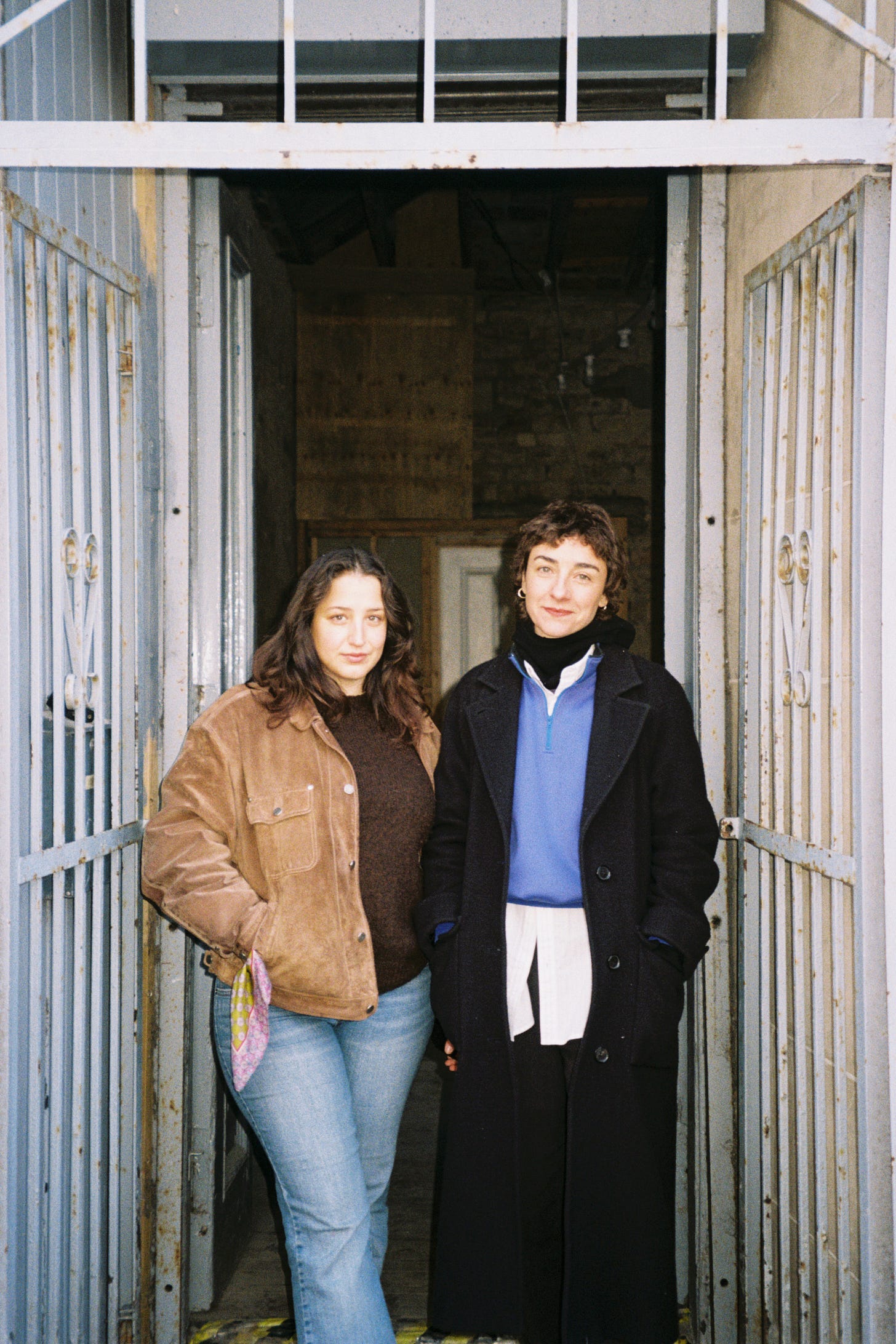
city is a curatorial duo founded in 2024 by Jennifer Aldred (b. Devon, England) and Renata Ottati (b. Guayaquil, Ecuador). The two met while on the Master of Fine Art course at the Glasgow School of Art. Since finishing the MFA in 2025, both Aldred and Ottati have curated a number of shows out of 25 Prince Edward Street, the current home of their curatorial project, as well as individually participating in shows throughout Europe and the Americas. Aldred’s most recent solo exhibition, Virgin Money, was housed at 25 Prince Edward Street in Glasgow. Ottati’s work can currently be seen in the group show CONTAINER at Slugtown in Newcastle, curated by 20 Albert Road, Glasgow, until 21st March. Their next curatorial endeavour as city will take place in April.
___
How did city come to be?
RO: It started pretty organically. I had just moved to Glasgow, as you know, lived in this crazy apartment, and it felt like a great opportunity to kind of, I don’t want to say make friends, but we just started the MFA and I was like, “okay. Let’s just do something outside of school”. And [Popcorn Machine, 2024] would be that first show pre-city. That went really well. It was such a fun experience, and I got the bug to do it again. Jen also wanted to do it again. So, we did it. I was still living in that place – the space was guiding.
JA: Renata had thought about running a space more generally in the past. And she said to me, “Jen, I’ve got this idea. I’d wanna do it with you. Are you up for it?”
RO: We realized that we worked well together. Our strengths were quite complementary to each other, and it was just like, “let’s just see what this could look like ”. It was such a nice thing coming out of the MFA. city was really born through all of us having moved here to do the course.
JA: Yeah. And it was not just friendships, but you do try to develop artistic relationships within the course. But you have to put effort in because, even though we’re all on this course together, it’s not a given that stuff’s gonna happen. The course is great, but you have to make it great. You have to mine it a bit.
RO: We were in cahoots I guess. June came along. It was a great opportunity. It was Glasgow International. You [Chaz] had moved in and were like, “You guys should use space again”. So then we started talking about Dusty (2024). That was a three-person show using a lot less of the space, but the same apartment, the same address, the same aesthetic. And that was, I think, very well received in my opinion. Dusty was the first show actually under city. We were making the flyer for it. We were really excited. We made the city Instagram in the emergency waiting room when Jen broke her arm.
JA: I think once we decided to do it, then you just got quite excited about what you should call it? The name came from Sex and the City. We just isolated the “city” from the old Sex and the City logo.
Two years in, city has become a bit more established. You have, maybe, a bit more of a professional outlook. Looking back at those two shows in the first year, how have you tailored your brand identity?
JA: I think that we have a nice, honest combination between elements that stay professional and then elements that are fun. It’s gotta be fun. You’ve gotta offset a certain amount of art world clinicalness. We were doing the thing in Google where you have to try and make an original email address. “city gallery” was gone. This is gone. That’s gone. Let’s be citygallerygirls@gmail.com and I think probably we’ll just have leaned into certain elements of femininity with it because we’re not trying to oppose that.
RO: Yeah. I feel that fun becomes a big antidote to the amount of work that comes into running a space. It’s a way to sort of balance that out. You do a lot of work. You do a lot of labour, and then the prize at the end of that is that it feels exciting.
RO: We’re both flirty in our own way. And that comes across in the way that we choose the name, the drinks we serve, in the way that the posts on Instagram happen. Maybe if you know us, you could guess when Jen’s posting versus when I’m posting. That is our own way of flirting.

What influences your curatorial decision making? How much does this differ from decisions you make in your own personal practices?
RO: We were talking about this a bit earlier, and I would say that it’s just a lot of trusting your taste and trusting what you gravitate towards and trusting your intuition. And then if we both do that, then we fall under a Venn diagram, let’s say, where you have my interest, Jen’s interests, and then the overlap becomes city’s interest.
JA: Yeah. And I think we both really trust that overlapping point. Things that we both like have worked for us. And it’s not theme based or from any kind of discourse necessarily.
But it’s like you said, there’s a flirtiness, a touch of femininity, but that’s not an overall theme that you’re specifically trying to hit.
JA: I think that we’re both quite aware of where our crossovers are, which then means that we kinda have developed this side eye for an artist that might work for city that falls neatly between us. The main difference with the personal practice is that we both work really independently. We don’t have collaborative practices. It becomes a collaboration if we’re doing a show together. And we talk about our work to each other all the time.
But when you’re working on your own work in your own studio, it’s quite solitary?
JA: Yeah. It’s so separate. And it’s on a different timetable.
RO: Our approach to the studio is very different. The executions are quite different. I make mostly sculpture at the moment. Being interested in a 2D plane versus 3D changes the way that you are making, building, or approaching certain concepts, even though the concepts might have a lot in common.
JA: And with a lot of differences between us, I think that’s a good thing because, if we’re programming, maybe Renata is more drawn to sculpture, maybe I’m more drawn to 2D. It diversifies what we’re bringing to the table rather than if we were both just painters.
RO: Our practices flirt with each other. Opposites attract. You know? There are hints of our conversations outside of city that become apparent in the practice. But not because we’re thinking similarly, but because we are sharing with each other. There is an exchange of information that goes on on a personal level and on a professional level.
JA: The thing that has happened with city that’s really nice and is something that we’ve learned about through doing the space is the support of the community. I’m hesitant to say “community” because it’s a word that is bandied about so much, but I could even describe myself and Renata’s relationship with each other as a community, just for starters.
RO: Yeah. And I think through doing city, being friends, both being artists, and both having our own personal practice, a lot of trust has been built. So, even if one of us doesn’t necessarily agree with an idea or a suggestion, we allow space for the other to figure it out. I think that was really nice about doing our own solo shows at the space. I felt like there was a lot of trust from Jen when I did my show. But there were also places where she was like, “maybe not!!”. And then simultaneously, when she did her show, it was the same.
JA: There was a really nice trust when we were doing our respective shows where we were almost held a little bit by each other. Maybe we take it for granted now, but it’s not that every artist has another artist that they can be in constant conversation with. For my show, me and Rosie [Higham-Stainton] had an email chain that was pages and pages. And, most people don’t wanna read that because it’s just very self-indulgent on my part. But Renata read the whole thing. When editing Renata’s text, we just sat down for a couple of hours together and really unpicked it. Even though we’ve done the MFA and undergraduate degrees, and we’ve both experienced strong art communities in different places, it’s not necessarily that common to find people that would give that much time and effort to each other’s practices. And I think city created that investment in each other.
RO: It’s also a huge amount of intimacy. There are a lot of things that I think about that I may never make, but I’ve probably told Jen. And I think that then allows me to be like, “oh, maybe it’s not that crazy. Maybe I can do this thing”. I am connecting these dots. Are these dots connected only to me? Does someone else see these dots that I’m connecting? And just having that space to read a long ass email or a text or just share something funny. You just go from that fun to then being like, let’s actually put a pin in it. Let’s revisit.

When starting city, what were your expectations for what it was or could become, and how has that changed in two years?
RO: I don’t think there were any expectations, to be honest. We did one thing that was fun, and went well and so we did another thing. At the beginning, we were still in the MFA and our priority at that time was the MFA. Then the more that we did city, the more that we wanted to keep on doing it.
JA: The expectations have changed. It’s show by show. You do the show, and then you’re like, okay, what are the expectations of our next show?
RO: Each show kept on teaching us what’s next. How much time do you need to prep? What is a nice timeframe to give an artist? It’s a learning experience as each show happens.
Oh my god. That’s so perfect because the next question is, what lessons have you learnt through city, and what would you do differently?
RO: I would do nothing differently and I’ve learnt everything, and we wouldn’t change anything. We change nothing. We do it all the same, and I’ve learnt everything.
JA: I guess it links back to the thing of how Renata and my practices have become intimate with each other. Through working with an artist on a show, you get an intimacy with their practice that, again, you don’t normally get in all social or artistic relationships.
Especially outside of academia.
JA: Yeah. You start out knowing a bit about people’s practices, but it’s so lovely to sit down for an hour or more with the artist and hear what’s going on inside their brain. And you’re like, wow, this is such a treat to understand how their idea for the show unfolded in relation to the space, in relation to us, in relation to the geography and everything. And then each artist you do that with, even though we know this inherently because we’re all we’re artists, you’re like, god, everyone works so differently, don’t they? And then it feeds back and gives you confidence in your own practice to be like, we all work so differently. It’s okay. I will work my way, on my time scale, on my agenda, on my rhythm. Whether it’s chaotic or systematic.
RO: I feel so honored that the people that we’ve approached have trusted us to care for their practice and show their practice to an audience that they maybe were not a part of before or hadn’t seen their work, and that is such a treat. For the most part, I would say that we’re pretty hands-off. We’re happy to be hands-on, of course. They’ve trusted us, and therefore, we trust them. I think that’s where this beautiful relationship develops where you’re just like, I like your work. I like your brain. We have the space. We have this project. Do you wanna participate? How can we be of help to you? It’s kind of like having a new boyfriend. All of a sudden, you’re in tune with the artists in a different way!
JA: You wake in the night and you’re like, “should Harry use toothpicks and not kebab skewers!?!”
Do you feel city is site-specific? Could you envision this project working in another place?
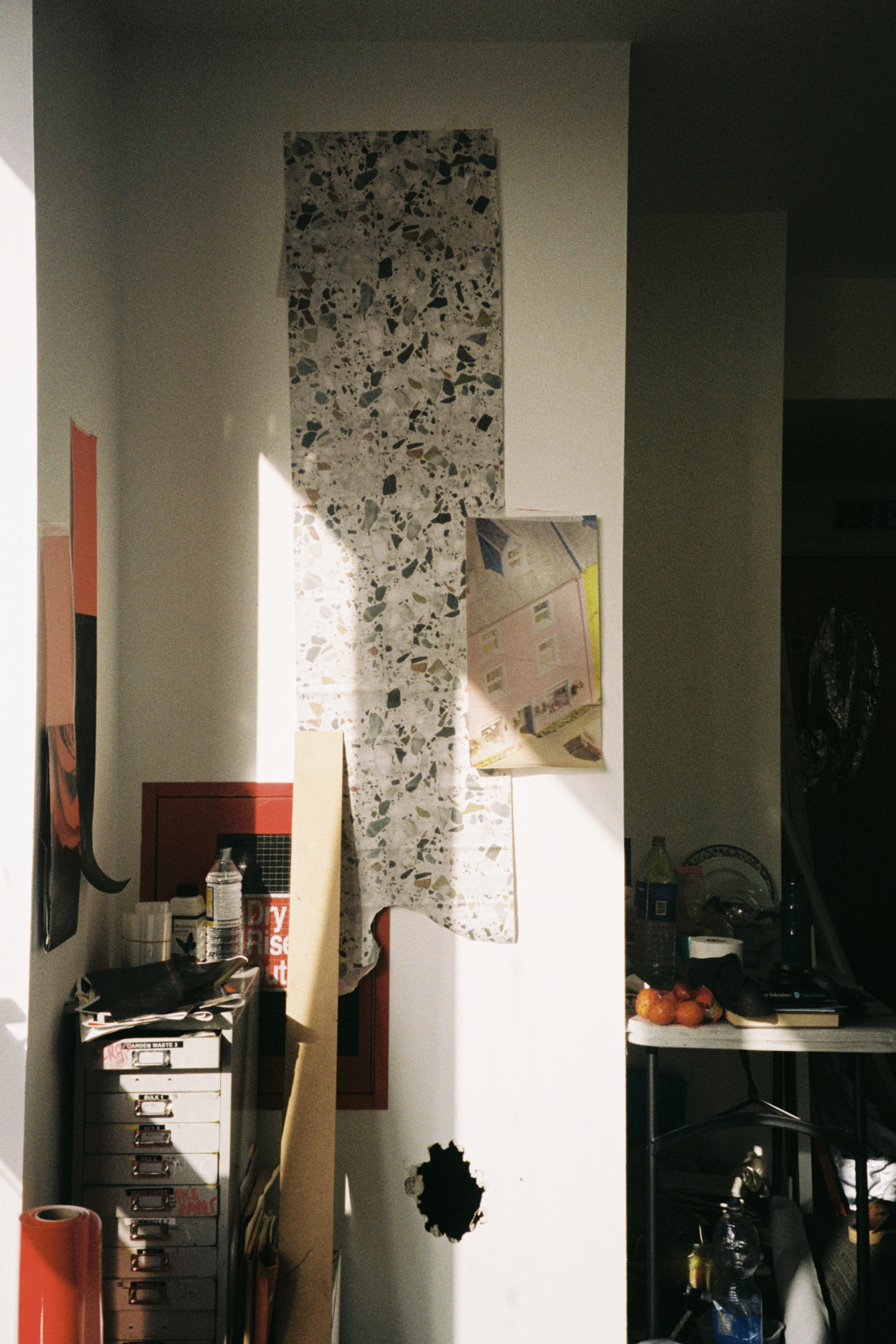
JA: We’re at 25 Prince Edward Street now, but we’re aware it might not always be there.
RO: I will say, it’s not site specific, but at this moment, I personally do believe that different spaces demand a different reaction and therefore, a different kind of artist. And if we were in a white cube, I’m sure that the program would reflect that.
JA: Prince Edward Street has been such a draw for artists. When we’ve approached artists that we don’t know and that we hope want to work with us, we’ll show them the space and they’ll get really excited. It’s like a lure.
RO: But the space is changing. It’s in the middle of renovations. It’s exciting to see the change and how different artists are going to react to that change. The project isn’t site-specific, but the shows maybe are.
JA: Or, like, it’s not tied to a site. But we’re probably both quite interested in how location affects work.
What are the biggest overlaps and differences you find in each of your practices compared to each other? How does this make it easier or more difficult to work together?
RO: Our relationship to the studio is very different. Jen is a nine to fiver, rise and grind. I love me an afternoon till late evening in the studio.
JA: You could say that actually that maximises our amount of hours because if I’m up at seven and she’s working till eleven, between us – that’s a long day. We’ve learned after two years that we operate quite differently. We operate quite differently in our lives, but we have worked really well to combine that. It’s like, if I’m good with a drill and Renata’s great with Instagram, you know, we’ve got many tools in our box.
RO: There’s a lot of respect in what we’re each good at. There is a lot of understanding of what’s Jen’s task, what’s my task, what we do together. I never feel like I’m doing something that I struggle with, or if I do, I don’t feel like I’m alone in it. I have no shame in calling Jen seven times in a row if it means that she needs to pick up the phone. And she has no shame in telling me to get off the phone. It goes both ways.
Renata, how does family/heritage/memory show itself in your work, if at all?
RO: It’s something that I’m constantly thinking about. Not necessarily how, but rather how much. I’m always looking for the fine line between the right amount of information and what assumptions can be made with that. Obviously, I’m in the privilege of knowing me, and I’m in the privilege of understanding my practice in ways that other people don’t.
It’s changed since moving to Glasgow. Moving constantly informs the work, and as the environment changes, it changes how I make decisions. And more importantly, it changes how I make the work. It’s constantly being reevaluated. I think of language a lot and the use of translation. How much you translate, what do you translate, what stays, what doesn’t stay. These are all questions that I attempt to answer within the practice. It is that battle, that in between, that I’m interested in. The balance of personal experience, versus concept, versus ideas that may be a bit more obscure. So, when I have a full answer, I’ll come back to you.
I just feel like when I read that question, I was telling Jen, “I don’t wanna answer this.”
JA: And I said “soften”. I was like, maybe you don’t always want to hold a barrier up to these questions around family and heritage.
RO: I just don’t know that I would use those words.
What words would you use? I’m thinking in terms of your work in the Dusty show. That was very nostalgic, family oriented, and having to do with the culture that you grew up in.
RO: For sure. I mean, it’s deeply about what makes me, me. The work is concerned with how I am built. What builds me? When? Where? Who? And what. Is it French? Is it English? Is it Spanish? Is it the little bit of Italian that I know? Is it the place that I visited two summers ago? Is it my friends? It just so happens that I am so close to my family. All of these things are largely encompassing. Distance plays a major part in that, and moving away from family has rooted itself further in the practice. And then that move is a negotiation that I’m constantly revisiting. I’m revisiting that negotiation every day. Back to that same question. That is a question that changes. Just like the answer changes all the time because I’m changing. The world around me is changing and the things that build me are changing. So, when there’s constant change, there’s constant work to be made.
Jen, what do words/wordplay contribute to your practice or the way that you engage with your work? E.g., the way that you title your work, phrases on your website such as ‘gloss peels back’, ‘G for Jen’, even your collaboration with Rosie for the text that you did for Virgin Money at city?
JA: I’ve always read a lot and always kind of thought about language a lot, and words, and writing. But not until quite recently have I really addressed this interest in language, or lent into words in relation to my practice.
What does leaning into that now feel like? Does it feel natural? Does it feel like you’re working a muscle that you haven’t worked in a while?
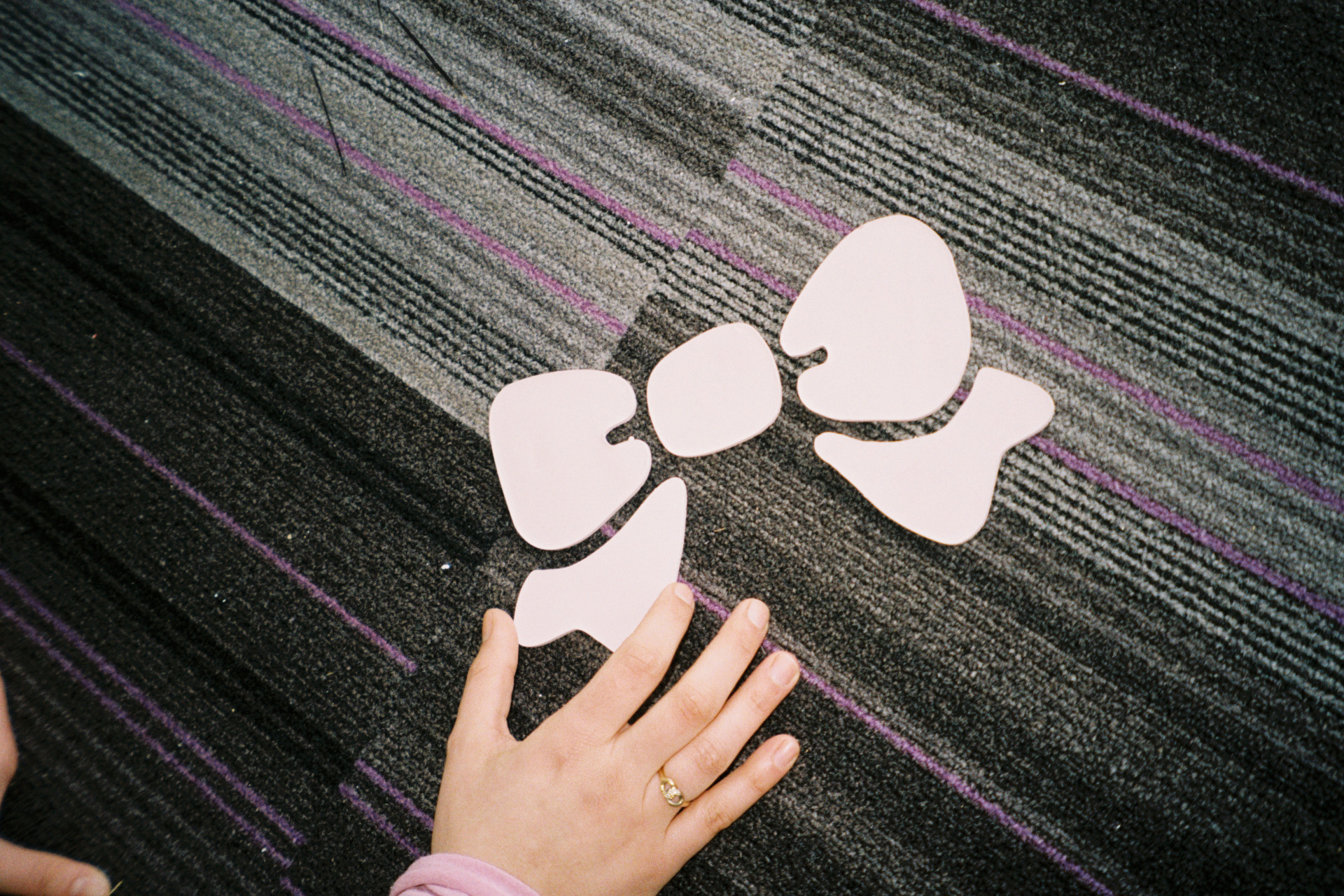
JA: It feels like an accumulation of a lot of time spent reading, and surrounded by literature and thinking about words and how language is used. But now for that to take some kind of material form feels good. And it feels like a tool that I can be quite agile with. Like, a tool I can utilize after an accumulative time with it. The ‘G for Jen’ is… my friend Nina was visiting, and we were in a charity shop and looking at these watches. I was looking at some quite nice little watch thinking, oh, I really want a watch. Like, oh, look, that leather strap and little gold face. And then Nina went, “no!. Look, Jen you clearly need that diamante bling bling one in the shape of a G.” I’m there thinking that I’m being classy with a little gold face leather strap, but then Nina put her finger on what I actually wanted. And it was £2.50. And the one I was looking at was, like, you know, loads of money. And then I wore the “G” out that night. When Renata saw it, she went, “Ahhhhhh, G for Jen!!” And then I just found that so hilarious. And it worked its way into the work. It’s light and funny, but it says something about how taste and identity can arrive from the side. How a thing as arbitrary as a letter, a name, a small arrangement of shapes becomes charged simply because, at some point, it gets attached to you. Also, I’d been working with this diamante necklace pendant that was in the shape of a P. And the “P” pendant had this link to my mum’s name, Pauline, but actually it was pretty incidental. I was just talking with Matt [Barnes] [who documented Virgin Money] about brands because, even though the work in Virgin Money is not branded words, it still deals with the way meaning gets poured into things that are essentially quite empty. A name, a necklace letter, a watch. Whether it’s Guess or Gucci, those structures give an object a kind of authority or emotional charge. The name Virgin Money, what actually is that? It’s kind of nothing. But we accept it as meaningful because of the systems around it. And I love “G for Jen” for that reason, and because it’s just funny, isn’t it? But it also highlights the kinds of failures of meaning in language. And when language and words are what our world is so heavily understood by or governed by or, like, they are these things that we are always using, and there are hierarchies between the written word and art, for instance. You know? I think about that a lot.
‘Gloss peels back’, that’s more, I suppose, poetic. It underscores a common double bind in the work between glamour and dirt. Whether it’s chipped nail varnish or the layers that build up on a billboard or a building. It’s like surface and facade. It’s like all of it is very much lots of things and nothing at all.
RO: I would say that’s a big overlap in both practices. The in-between everything and nothing is a constant thing that we’re both thinking about, and they exist in each practice very differently. Yeah. I would say that’s, you know, within the Venn diagram of both ourselves and city, emptiness and everything. E and E.
JA: Language just, like, helps me think. ‘G for Jen’ helps me think.
Any shout-outs?
RO: I think we wanna say that city would not exist without the help of many friends. Not a singular one in particular, but a multitude. We were really encouraged by the people around us to keep going. Shout out to our people for being our people. People make Glasgow. People make city. We’ve had so much help and support. As a self-funded project, this would not exist without our friends and the people who help and encourage it to exist.
JA: And it means so much for people just to fucking say, like, what you’re doing is great.
RO: A little thumbs up goes on my way. Like, share, follow, subscribe. citycitycity dot city.
JA: But honestly, like, even when Matt [Barnes] left the gallery today, he was like, “You’re putting on really good shows.” That’s one sentence, and sometimes that’s more important than other types of support. People wanting to see what we’re gonna do next makes us wanna keep going.

___
In the Studio is a new monthly series interviewing Scotland-based artists and curators in their studios, conducted by Chaz Scott, a curator and art historian based between Baltimore, Maryland and Glasgow, Scotland.