
In the Studio
In the Studio: Erica Eyres
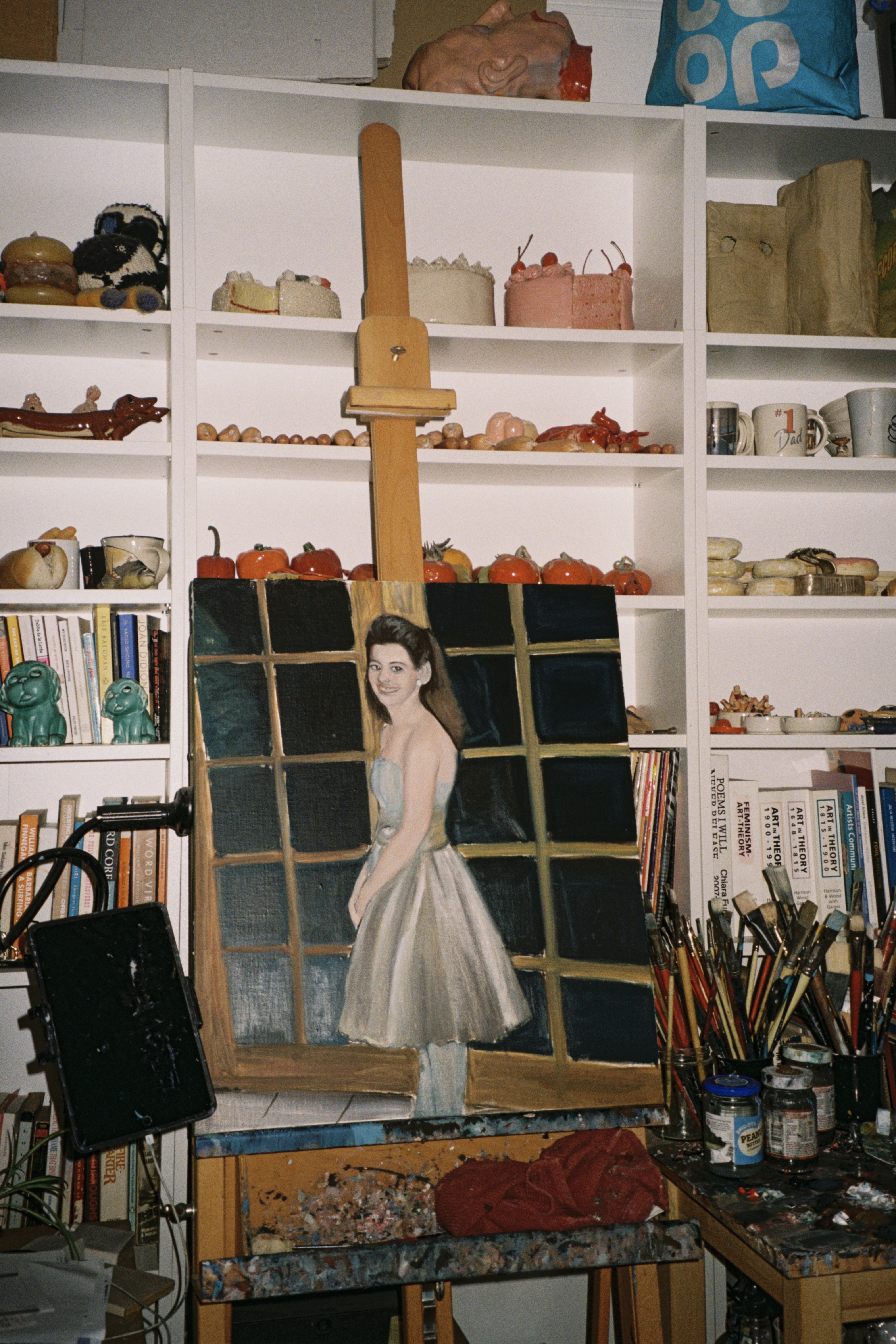
Erica Eyres is a Winnipeg-born artist based in Glasgow. She works across drawing, painting, performance, and ceramic sculpture. Popular motifs in her work include: nudity/the body, deadpan comedy, and vulnerability. Eyres has had solo exhibitions in Winnipeg, Glasgow, Copenhagen, London, Zurich, and Reykjavik. She currently has work on view in Between Sight and Breath at Kendall Koppe Gallery in Glasgow, open until the 13th of March.
_
How did you end up in Glasgow? How has your work developed since arriving?
I came to Glasgow to do my MFA in 2002 and then just ended up staying for twenty plus years. When I was studying, I was doing a lot of videos, maybe more drawing and some sculpture, but not ceramics [yet]. After I graduated, I kept developing the drawings. During the pandemic, I started doing the paintings, but that grew out of the drawing. Around 2014, I started bringing clay back into my practice.
Your practice has often been described by yourself and other interviewers as “corpse-like”. How did it feel originally hearing your work described this way and how does it specifically relate to your sculptural work?
I would say the early sculptures I was doing when I was in my BA were corpses, basically more like dead animals, so it made sense to me. I know what they mean by that. And I’d always thought about objects in this way where I’ve had this kind of influential moment after my father died of going into the house and looking for things and just the kind of eeriness of everything. When it feels like someone’s been there recently, but they’re not there, and it almost feels like they could just walk in any moment, and that’s kind of always influenced how I approached sculpture in some strange way. And maybe the way I try to position them where it looks like they’ve just been kind of randomly set down. So, yeah, it made sense to me, that word. That is a good word for it.
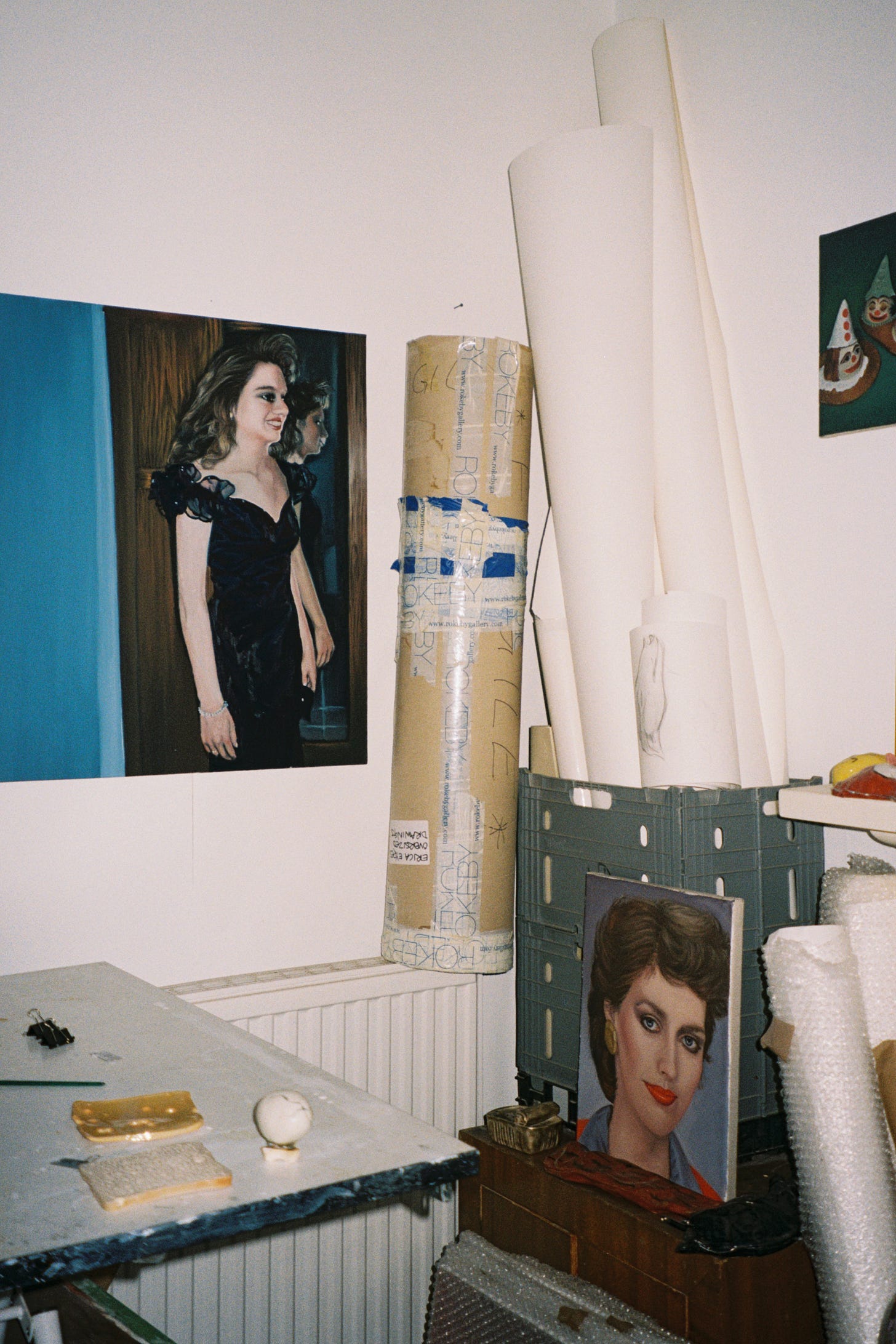
I’ve told you this before, but I’m really interested in the way you depict women and your relationship to women. Tell me about the women you depict in your paintings. Are they women you know, or are they sourced from somewhere?
Yes. They are always sourced from somewhere else. Sometimes that’s vintage magazines. Sometimes it’s from textbooks. More recently, I was using these dermatology and trichology textbooks. I’ll sometimes get into a certain source and then start hoarding lots of them. I’ll just become obsessed with trying to find more copies of them, or has the author written other things? I just can’t really seem to get enough of it. And then I’ll narrow it down. And I think there’s just certain images that’ll just have a stronger pull to them.
What do you feel like the through line is with those images, if you have been able to identify it?
There’s definitely something that catches me off guard about them. Like, there’s just something odd about them. And it depends on the source. I would prefer ones where there’s eye contact because I think there’s something uncomfortable about that. It kind of complicates that relationship with the viewer where I mean, even for me, I sometimes feel like they’re looking at me and, like, they want something. In terms of female bodies, I guess that’s part of the reason for looking at older sources. I’m not particularly interested in newer magazines or even images. I feel like it’s so much more uniform. I feel like everything is just because of the standards we have for bodies and the way that women look today, which isn’t to say there weren’t standards previously, but they’re so different. I just feel like I’m desensitised to more contemporary images in some way. I think, because of social media, you just pass stuff by, and maybe you pause for a second, but there’s not much pull in them. So, it’s sort of hard to describe the thing. It’s just a kind of weird uncanny quality to an image. And so then I’ll eventually have a file of them, and then I’ll play around with cropping them in different ways and maybe doing something to the image in some way.
I’m also interested in images where it’s almost like they’re mimicking something they’ve seen before, like a certain type of pose, but there’s something about the way they’re doing it that isn’t quite the same. Like, there’s something a little bit amateur about it. There’s something a bit off that, you know, maybe makes you more aware that they’re performing something that they’ve seen before, you know? There’s something a little bit off about it. But then at the same time, they seem quite comfortable with having their image taken, which is something I’m interested in because I really hate it. When I have my photo taken, I get so stiff and uncomfortable. And then I think there is a kind of thing where I’m trying to put myself inside of them in some strange way. They’re kind of mimicking something, but then I feel like I’m kind of trying to mimic or reflect something they’re doing.
There is one description of a series of work you did that was taken from older, vintage pornographic magazines. You depict women in general, but specifically in stages of undress or nude. That’s a recurring motif in your work. Can you talk to me more about that specific series of paintings taken from those pornographic magazines? And what role does nudity specifically serve in those paintings?
In terms of nudity, there’s a sort of state of vulnerability. But also different types of bodies as well. Like, they’re not, I suppose, the kind of bodies you’re confronted with all the time. It’s funny. I suppose nudity is something I’ve also kind of played with in different forms that, for example, there was this at one point where I just focused in on the faces for a while because I thought, oh, maybe it’s actually the faces I’m interested in and the kind of expressions people make in these photos, you know? Or say, there was a different series, but there was one based on these fetish magazines, and, with those types of magazines, there’s always a kind of sequence that happens of this undressing. And sometimes I’d be more interested in the one at the beginning where before the clothes come off, there’s something more awkward about that. I’m kind of interested in pornographic images, but it’s not necessarily for the kind of eroticism or the pornographic element, you know what I mean? It’s more the sort of poses that’s happening and the relationship between model and photographer that’s happening, and the space that’s created around them.
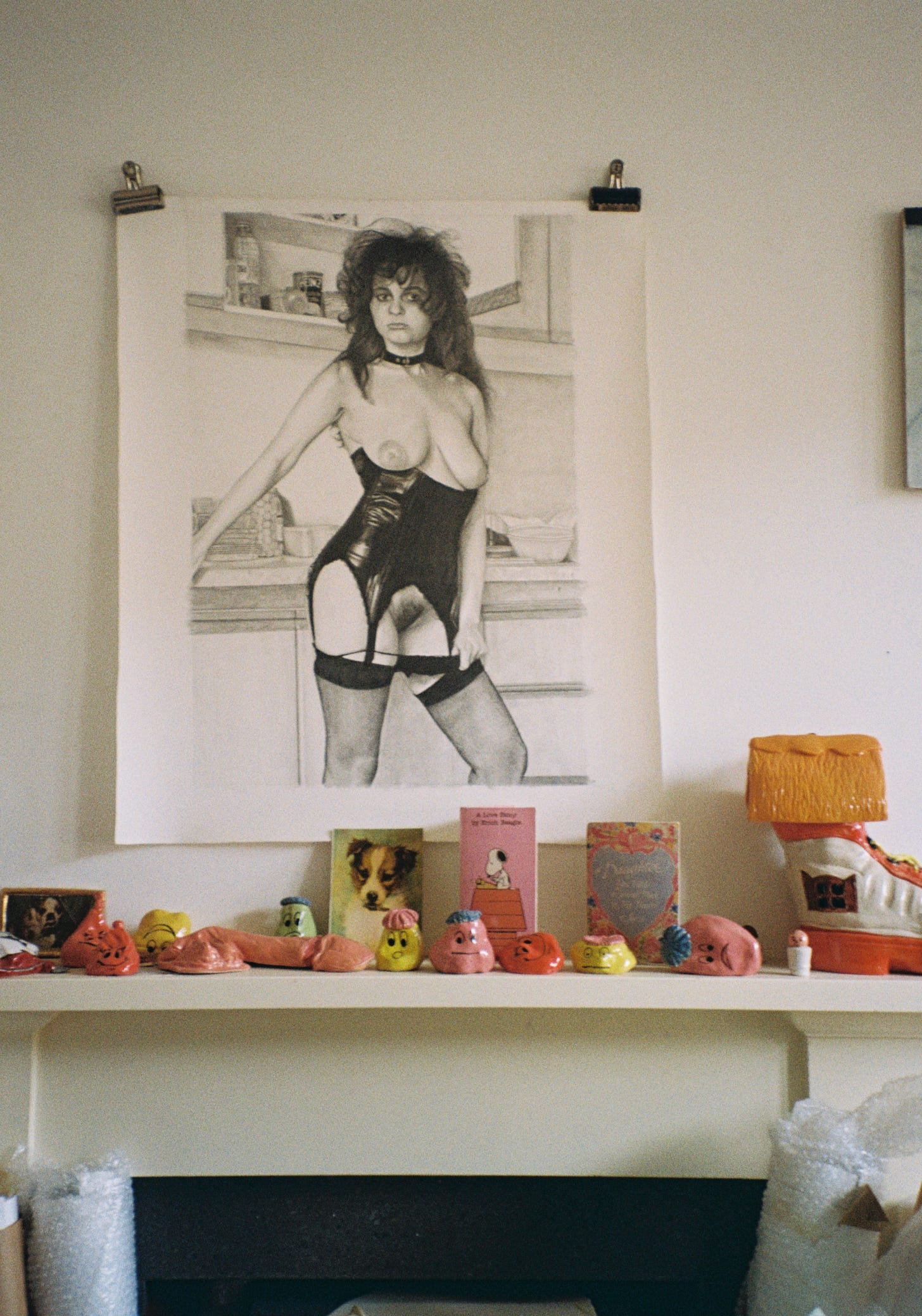
Oftentimes when you’re painting serious eye contact with the viewer, I think there’s this uncanny quality and also a vulnerability. And I think what’s interesting to me about the works in that series is that it doesn’t feel like the women are the butt of a joke even though humor is something that is found a lot within your work. It doesn’t feel like you’re making a joke of the awkwardness of the image. I think it’s interesting how attitudes change because you have these bodies that, today would be deemed as maybe grotesque or unattractive, and still it doesn’t feel that way looking at these images. When I look at those paintings, it’s funny in the way that these women are posed. It looks like somebody copying things that they’ve seen other people do that’s perceived as sexy, but it’s not funny in a “this body is funny” or “this face is funny”.
Sometimes I think what’s funny is the sort of discomfort in people that it creates. And it depends on where they are being shown. I actually find people in Glasgow to be a bit more funny about bodies. The first time I showed them was at this two person show in Copenhagen, and I was really nervous about it just because I’d never shown these paintings or had a show of paintings in a really long time. And I just never really know what kind of reaction people are going to have to them. And, I mean, they just assumed it was no big deal at all. I think because they have a different relationship to nudity in Scandinavia, I guess. Whereas here, people just will make more jokes about it or I remember somebody saying “well, I just didn’t think I could bring the children”. And, well, they’re not, like, poor or sexual. They’re just bodies in the end, really. I guess too, I feel something does change by remaking them. I become the photographer in that situation. I try to put myself into that position of making the image and from the point of view of the photographer. But then it’s such a different process. Photography is so instant and painting is this kind of laborious process. I think you do have to have a certain amount of care that goes into it.
Because of the eye contact you employ, these women don’t seem shy. They’re not trying to be demure. There’s an inherent confidence in a lot of those images that demands the viewer to see them in that way as well. If they were looking away or off-centre, you could assume so many different things about that image that the eye contact kind of takes away.
There’s something very purposeful about the pose whereas, if you think of life drawing and the images that are created through life drawing, the person is usually looking away. And I always feel like it’s meant to give you this illusion that you’ve just that you’re kind of spying on someone. Like you’re not actually engaging with this nude person in front of you so you can kind of depersonalise them in a way. They just become a body rather than a person or a character. There is something too where I’m a bit in admiration of the figures I’m painting. Not jealous exactly, but I wish I was able to approach a camera in that way. I don’t actually know that being photogenic has anything to do with how you look. It’s just maybe more to do with how comfortable you are having your photograph taken.
Speaking of being on camera, where does your inspiration for your performance pieces come from? What is the process in creating these works in that medium, and how does it differ from the process of making your two and three-dimensional work?
The initial ideas come pretty randomly, and I often feel like this is really stupid or what a dumb idea. But then I get to a point where there’s a certain amount of pressure to do it, then I’ll be like, wow, this is the idea you’ve got, so you’re just going to have to work with it. Sometimes I think it doesn’t even really matter, you know? It’s more how it develops as you’re doing it that’s more important. But say, for example, that one [Learn to Dance, single-channel video projection, 2023], I had this weird video because I went through this phase of collecting a lot of VHS tapes and was trying to digitise them and work with found footage. And it wasn’t really successful. But I had this thought about remaking this video that I had. It was this video called ‘Learn to Lap Dance’ that was this woman teaching other women to lap dance. There were no men involved in it at all. And they’re in this club looking place. Maybe it’s somewhere in a strip club or something, I’m not sure. And she’s just really intense. Her eyes are really wide open and she’s going like “Yes. That was very good. Yes.” and then they’ll be like, “oh, yeah. I was really nervous.” I thought this video was so funny because I was like, who is this for? Is it genuinely to teach women, or is it something men are watching? My first idea was that I’m going to remake this video and so I started writing down all the dialogue and then at some point, I couldn’t even get through writing it all because I was like, no, that’s not it. That’s kind of boring just to copy it verbatim, I don’t know if that really interests me. At that time, I was doing a lot of stuff with those ‘For Dummies’ books. There was one called Building Confidence for Dummies, so I took stuff from that and put it into the script. Eventually, it became more like a dance you could do that would give you some kind of renewed confidence. I also started bringing in nonsensical psychoanalysis language. The characters were partly based on the women in the original video, but then they became their own thing. I’ll usually begin with a wig or some feature and start trying to speak like them. Sometimes it takes a bit of time. I’ll maybe film a bit and then be like, oh, I’m not really convinced by that and will just redo it. Sometimes the ideas just come as a kind of weird random thought, and then it just gets developed through the making. It’s a very different process than the 2d or 3d work in that I do find [performance] much more mentally taxing. I am usually putting it off. Once I’m in it, then there’s a certain momentum that keeps me going. But I do feel myself being like, oh, just start. Just start. Just do it, and then resisting it for a long time. Whereas painting or sculpture doesn’t require the same parts. Also, because it taps into this thing of being on camera being uncomfortable for me. I developed this thing of being in disguise and being different characters. Quite often, there’s a theme of women in it that are very overly overbearing or overly confident. I guess there’s a kind of crossover there with the painting. There is something kind of weirdly fun or liberating about trying to inhabit that.
How does the work that you did on deadpan comedy in contemporary art during your PhD factor into your practice? What role, if any, does it play in your work in and outside of performance?
When I was writing it, I had a stronger focus on video at the time. But I suppose at some point, it also became about how it can be performed in other media too. It came to encompass other media just because I was working in other media, but also the things I was looking at. So, that would be photography, you know, like Cindy Sherman, but then also other practices like Richard Prince. It’s connected in that I see them all as performative in one level or another. Even with the painting, that idea of people mimicking kind of became part of it too. I suppose too, it’s that way in which you’re not really sure if something’s meant to be funny or not. That there’s maybe a similar response to the paintings as there would be to videos. A lot of it came through the videos in terms of having a screening where sometimes people would really laugh at it and you’d get a great response. Then other times, I’ve had just absolutely no laughter. And it’s probably people responding to other people not laughing. So, maybe there’s one person who wants to laugh, but they’re like, oh, it’s not appropriate or oh, no, I shouldn’t. What really interests me is the absence of laughter. Maybe the appropriate response isn’t necessarily laughing, but that it’s also about discomfort. In the same way the paintings get these different reactions that are sometimes uncomfortable. Sometimes people are laughing or creating these narratives that they’re projecting onto it and being like, oh, that looks like so and so, you know? So sometimes, in terms of the titles, I’ll be quite deadpan because I do think titles are an interesting thing to play with. If the humor was turned up too high, then that wouldn’t be deadpan anymore. It’d be something else. It’s riding these kind of fine lines and this push pull thing of how far is too far, or maybe walk it back a bit.
How does nostalgia affect what you depict in your ceramic work?
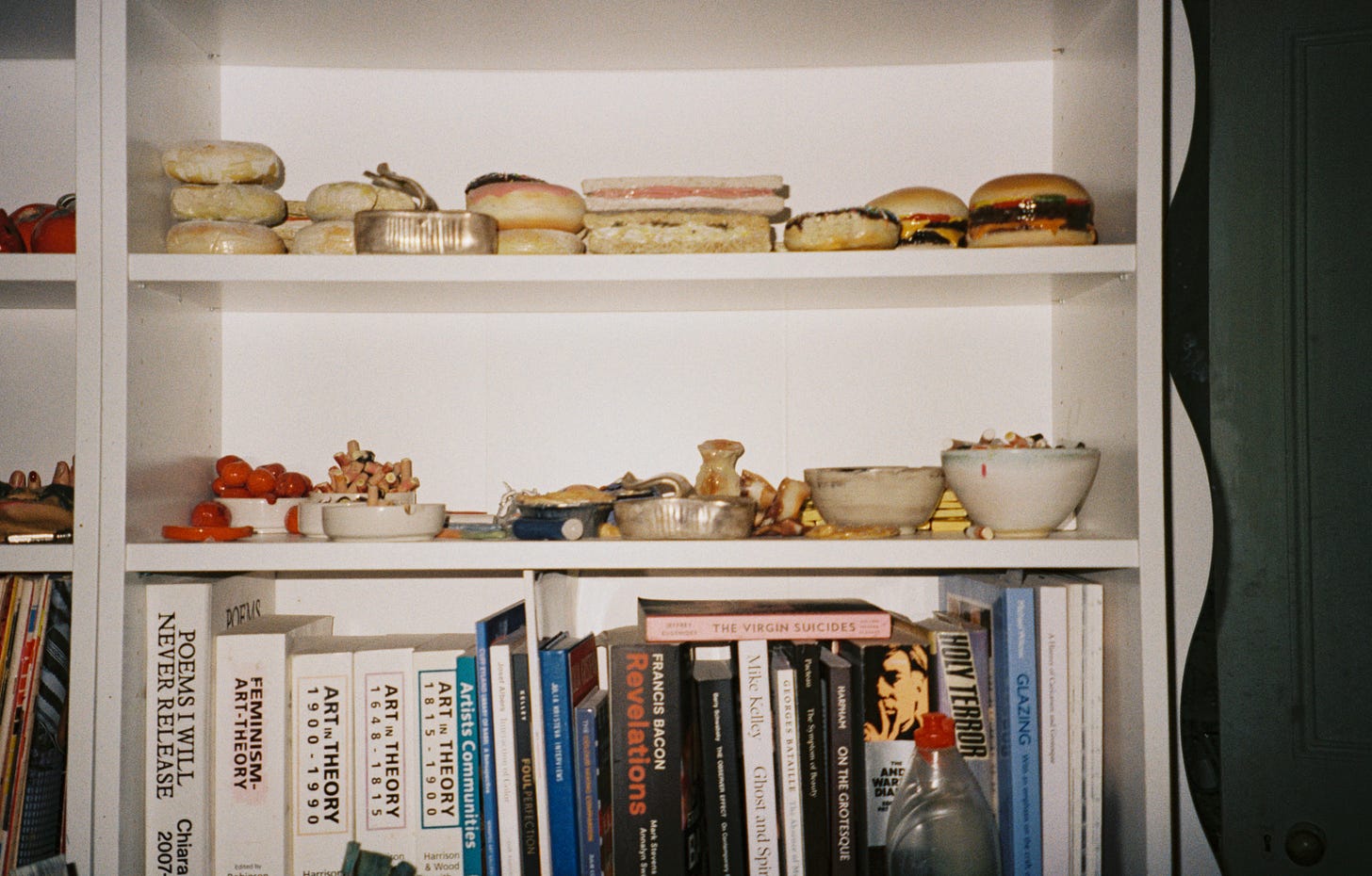
It’s often based on objects that I remember. Not necessarily specific objects, but tapping into things that I remember. But also that other people remember too. I feel like there’s certain things, like a cereal bowl with milk and a few pieces left, that there’s something about that image that people seem to resonate with. It doesn’t necessarily have to be from a certain era. Sometimes it is from a particular time, like when I would have been a kid, but other times it’s more ambiguous than that. So, it’s nostalgia, but I’m also interested in how nostalgia can be good or bad, you know? That it can be something that acts as a kind of trap. To think that the past is better for some reason or that you have to get back to it. I’m interested in that ambiguity or that people have these very different relationships and memories.
Between your full time work at the art school and a full time art practice, how do you go about your day to day, and how do you set aside time to make work?
I work four days a week, so I still get one day off. There’s a lot cramped into the weekend. I think it helps too having the studio at home. If I get home from work at a decent time, I can do a bit. Even if it’s not a lot, it helps. In some ways, if you have a studio outside the home, maybe that makes you more productive in the way that you could just have a day and you just fill the day with that. The way I work often requires a lot of layers. In terms of the painting, it’s like, do a layer, let it dry, do another one. And the ceramics are like, do a little bit, let it dry, work into it again. So it sort of suits me better to do everything in these accumulative stages. Not having children, the time you have off of work is like your own so it’s not like I have other things I’m having to do. When I wasn’t working as much, in a way, I felt like it was too much time to think and agonise over things or worry about things. I’m actually more productive having a shortened span of time. It condenses time in a way that can be more productive. It forces you to focus.
___
In the Studio is a new monthly series interviewing Scotland-based artists and curators in their studios, conducted by Chaz Scott, a curator and art historian based between Baltimore, Maryland and Glasgow, Scotland.