
In the Studio
In the Studio: Hardeep Pandhal
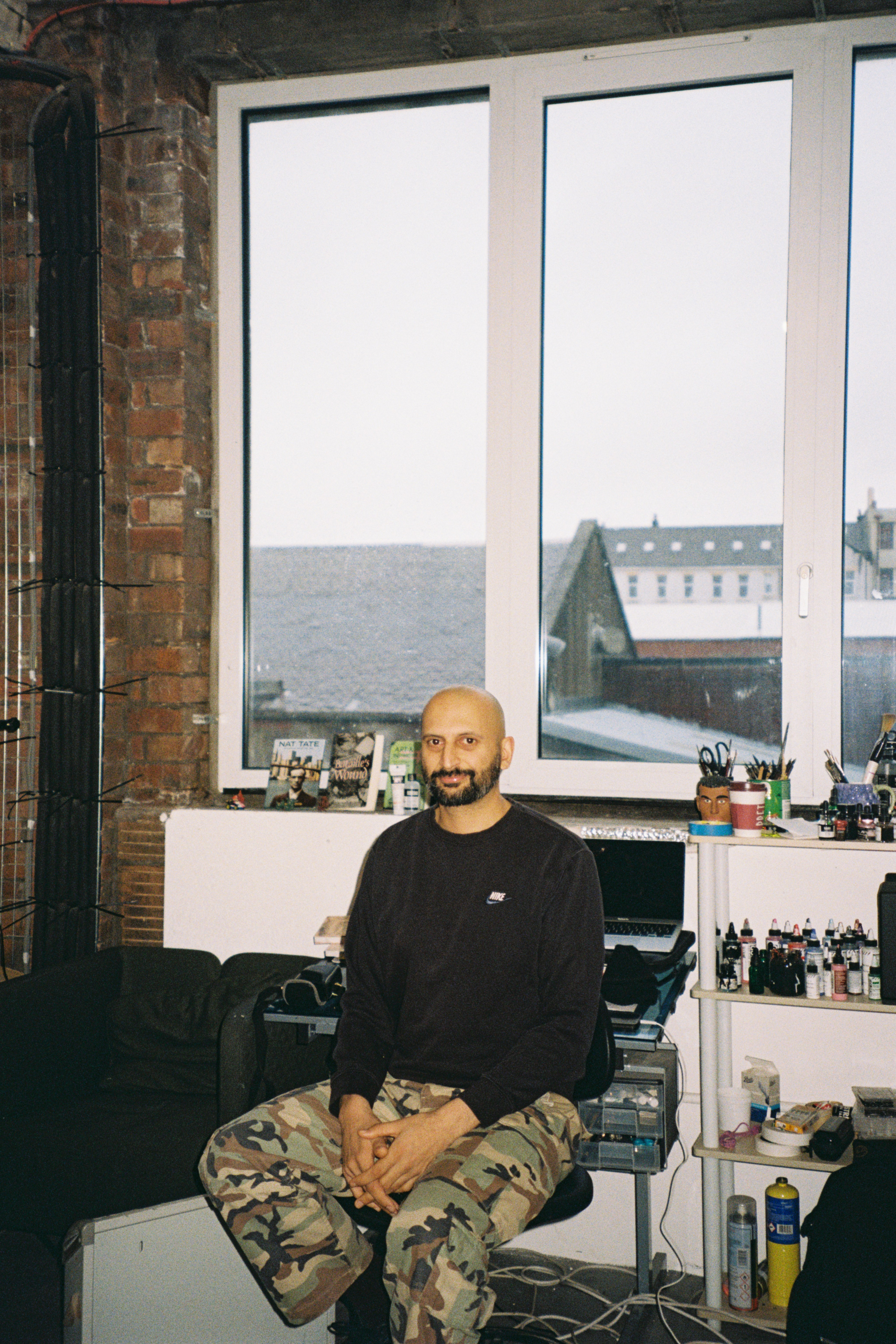
Hardeep Pandhal is a British Indian artist born in Birmingham and based in Glasgow. Pandhal received his BA from Leeds Beckett University in 2007 and completed his MFA at the Glasgow School of Art in 2013. He has had national and international shows with works spanning performance, collage, large scale drawings and music. Pandhal’s most recent series of work, Saag and Fish Fingers, is on display at Midlands Art Centre (MAC) in Birmingham until the 1st of February.
_
Could you give me a standard artist biography? If we were on your Wikipedia ‘early life’ section, what would it say?
I was born and raised in Birmingham, England, in the mid-eighties, and I stayed there until I was eighteen. I have one older brother and two parents, and they are both Indian, from a Sikh background. I didn’t practice the religion strictly or anything, but I was kind of involved in Sikh family events and had an understanding of Sikh culture. I went to Leeds to do my undergraduate degree in fine art, and I stayed in Leeds maybe in total for about seven years. So, I stayed for a few years afterwards, you know, working in a cafe and stuff, and then doing some projects with friends and things like that, but felt maybe that there was little room for progression in terms of opportunities that would allow me to understand my work in a more international context. So I applied to do an MFA here eventually, in Glasgow, and I got a scholarship for it, which was really good. I think the difference maybe in terms of what I could do in Leeds and what I could do [in Glasgow] was noticeable in terms of opportunities and also maybe professional development…
Why do you think that is?
I think maybe there was a generation previously [in Glasgow] that had opportunities and have drawn the wider art world into the city as well. So, it’s like there’s a history of art in the city that’s different. And I think the art school and graduates, and maybe funding opportunities as well, has meant that there’s more to do and less of a kind of a hierarchy between an artist that is established and maybe someone that’s just coming out of an art school context. But I think Leeds has since kind of developed. I think there’s more stuff going on there, and I think it’s more appealing now than it was for me when I was there. But the city of Leeds in itself is really cool because it has three art schools there. It’s quite a fun city, music-wise and it’s socially interesting too.
I’m most familiar with your work in its current iteration and what I’ve seen in person and what I’ve seen online, but I’m interested in how the way that you work and the work that you’ve been making has changed from when you were at Leeds versus when you did your master’s to now. Are the themes similar? Obviously, it would look different, but do you feel like you were kind of revisiting these same topics that you’re thinking about now just in different formats?
In a way, yes. I think some of the work in that degree show is still kinda relevant, but I think it felt more like I was presenting, or editing my research. So, there wasn’t much refinement regarding my material practice. It was more like, you know, I was making video trailers out of ethnographic films from the seventies and eighties. The ones that have been criticised for being, you know, sort of eurocentric and sort of, like, essentialising, you know, other cultures and things like that. That criticism was available in the textbooks I was researching. The films are really interesting, but they are problematic in terms of the way that the subjects are kinda, like, portrayed and stuff. So I made these kind of weird trailers out of them, to almost, like, make it more explicit that these are, like, really weird and fucked up. So it wasn’t like I was trying to, like, say this is wrong. You can’t be moralistic about it. My approach to that was, oh, let’s make the viewer more uncomfortable or, like, you know, sort of test the school and my peers and all that stuff.
Minority artists often feel they need to put their identity at the forefront to gain any kind of opportunity. Your work is personal to you, but you’re also using these aspects of your identity as a reference in a very, light-hearted way. For you, someone whose upbringing and identity is already inherently a part of their work and practice, how do you come to terms with the expectations that people may have of you, or their interpretations of your work without themselves having the cultural context?
Some people are very cautious of it. I thought, I’m just gonna associate myself with people who I’m genuinely interested in and who can articulate things, you know, not necessarily intellectually, but just, like, in a human way. I’ve done loads of interviews, and there’s lots of texts on me out there, and I’m really happy with a lot of it. So it’s like, not everyone’s gonna read it all or understand it all or, like, pay attention to it immediately. But I know it’s out there and people that I work with will know it’s out there as well, and that’s the only thing that makes me sort of reconcile any potential burden around representation.
When people who are viewing this work, specifically, white people, do you often find that you’re having to maybe deal with their discomfort with the work and then that is something that makes you think about your work in a different way?
I used to. I used to be a bit more like that, and I think maybe the context of the art world’s changed a little bit since I’ve been around. I think there’s more artists who are from similar backgrounds to me, which has actually made it a lot easier for me to kinda continue with my shit. And I think at some point, I was maybe being self-conscious of depicting a straight soldier guy. But I’m straight. I’m not gonna change what I am about. I think there was a realisation at some point that some marginalised subjects are perceived to be less marginalised than others, depending on the context. Rather than let this realisation hinder my work, it gave me more of an incentive to keep going with it.
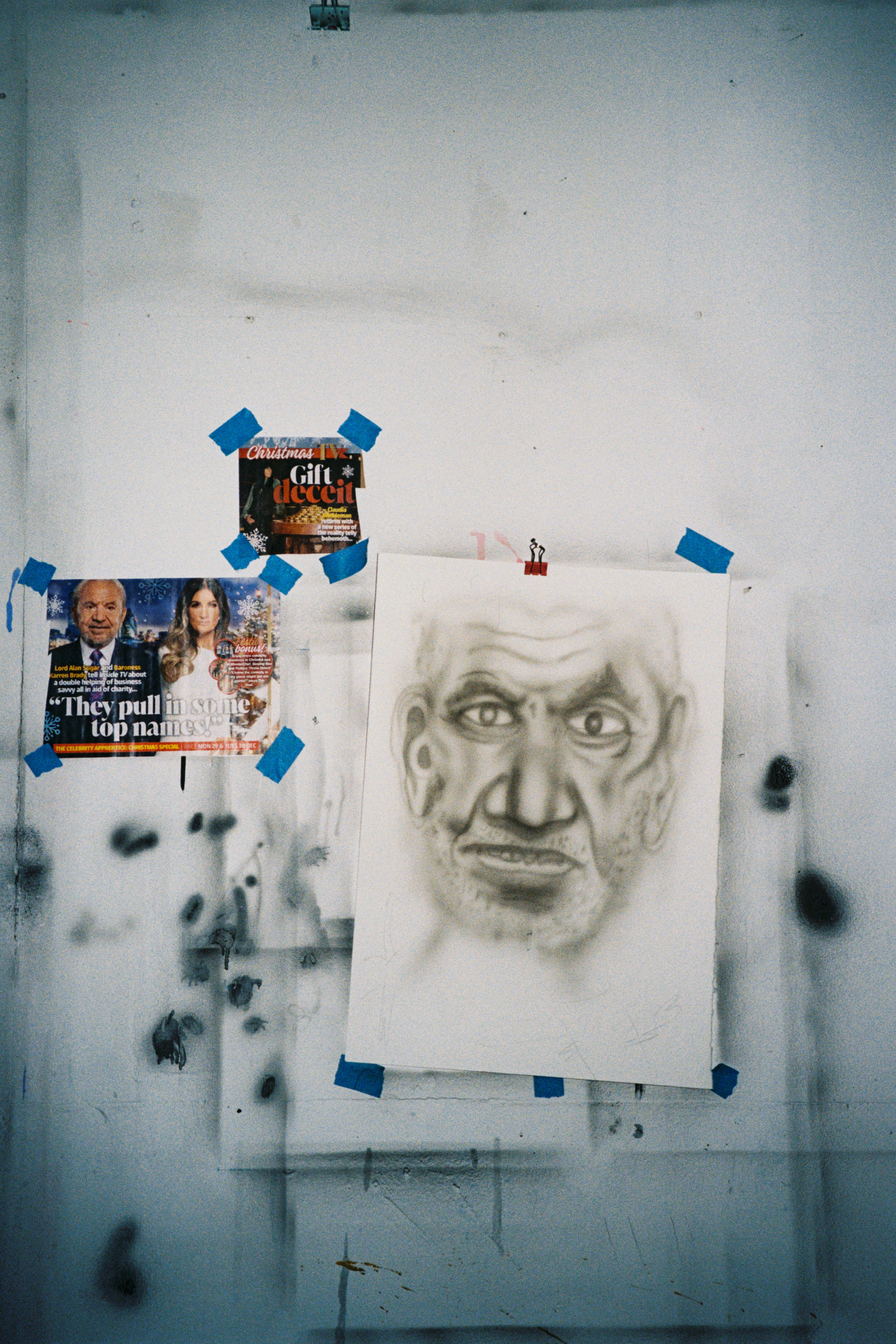
You build worlds in your works and I’m interested in the narrative within that world. Where do you source your own material from? Who are you depicting in your images? Who are these characters?
In the past, I would be fairly intuitive and spontaneous, but I would also be thinking about projects or contexts, or certain conditional opportunities where I would respond to something, you know? Now, I’m just purely thinking about what’s formally interesting and important for me. So, it started with some drawings that I did in Leeds. Maybe two or three years after my degree course, I started doing drawings of British Sikh soldiers. I didn’t know that British Indian soldiers fought for the UK. I didn’t know that Sikhs had fought for the UK in World War Two and that so many people from the Punjab area in India were serving in the military. The colonialists believed that the Punjabis were a martial race. So, their idea was based on race science or eugenics, and I thought, that’s kind of, like, weird, but also kinda cool. You know, for me in a boyish way. In a weird way, it was kind of affirming. It contradicts the orientalist stereotype. So, it’s like, I’m really interested in this thing, this history, and I wanna reference it and explore it in my work, or if I have an opportunity to make an exhibition, then make this subject kind of central to it. So, it’s like, they look like gnomes or they’re kind of a bit comical or something. And then they have guns and, you know, and they’re kind of a bit droopy and it’s just how I ended up drawing generally. So it’s like this figure is connected to the way I draw. It’s almost like a mascot, like a kind of avatar or sort of trademark or signature. I thought this is gonna be my identity as an artist. This is what I’m gonna present. And being aware of all of those connotations, but also maybe of some expectations, as there weren’t many Sikhs in the art world at that time, I knew there’d be a lot of, like, work around interpretation to do. I was comfortable with this, and felt I could still use humour.
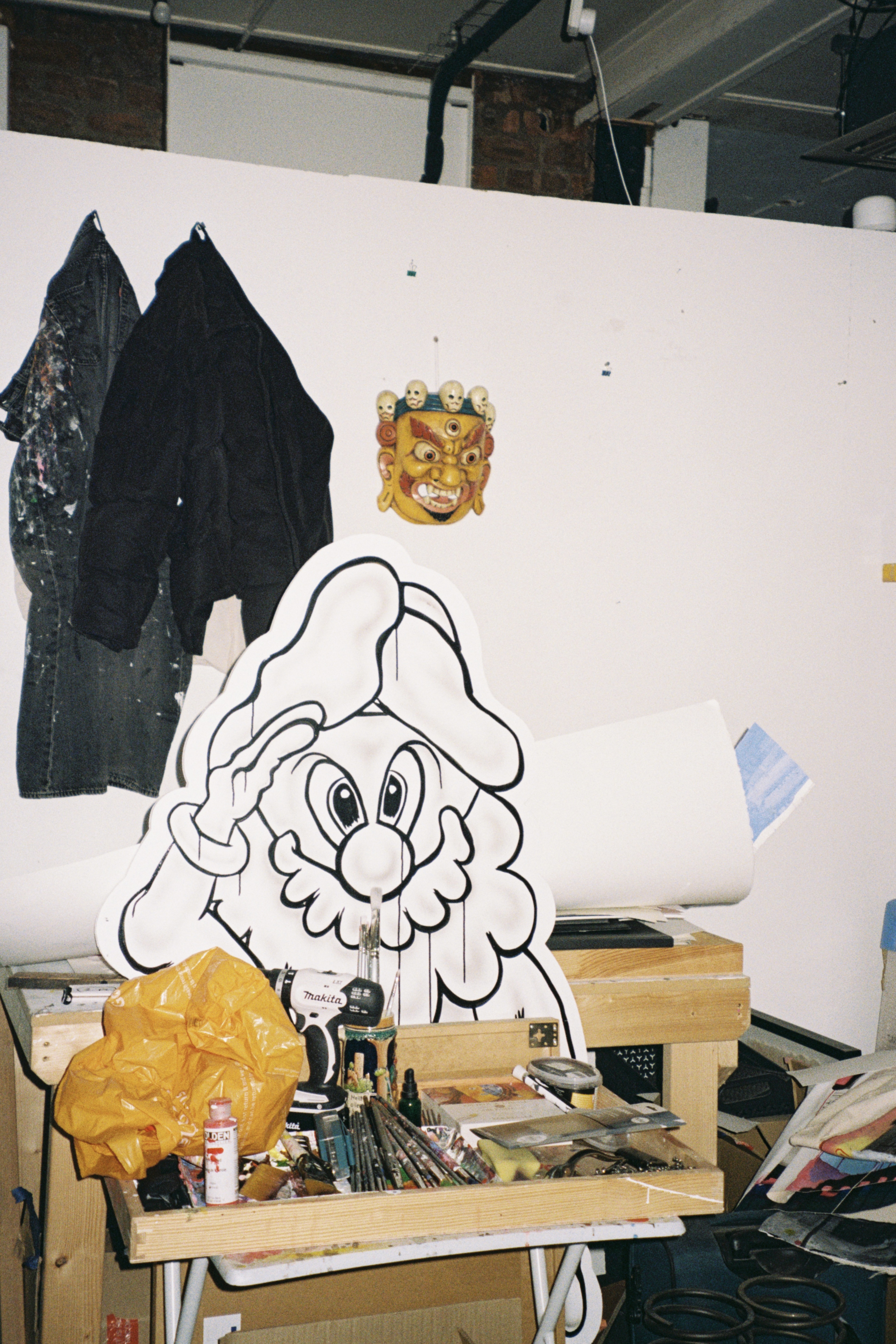
How are you structuring your work now?
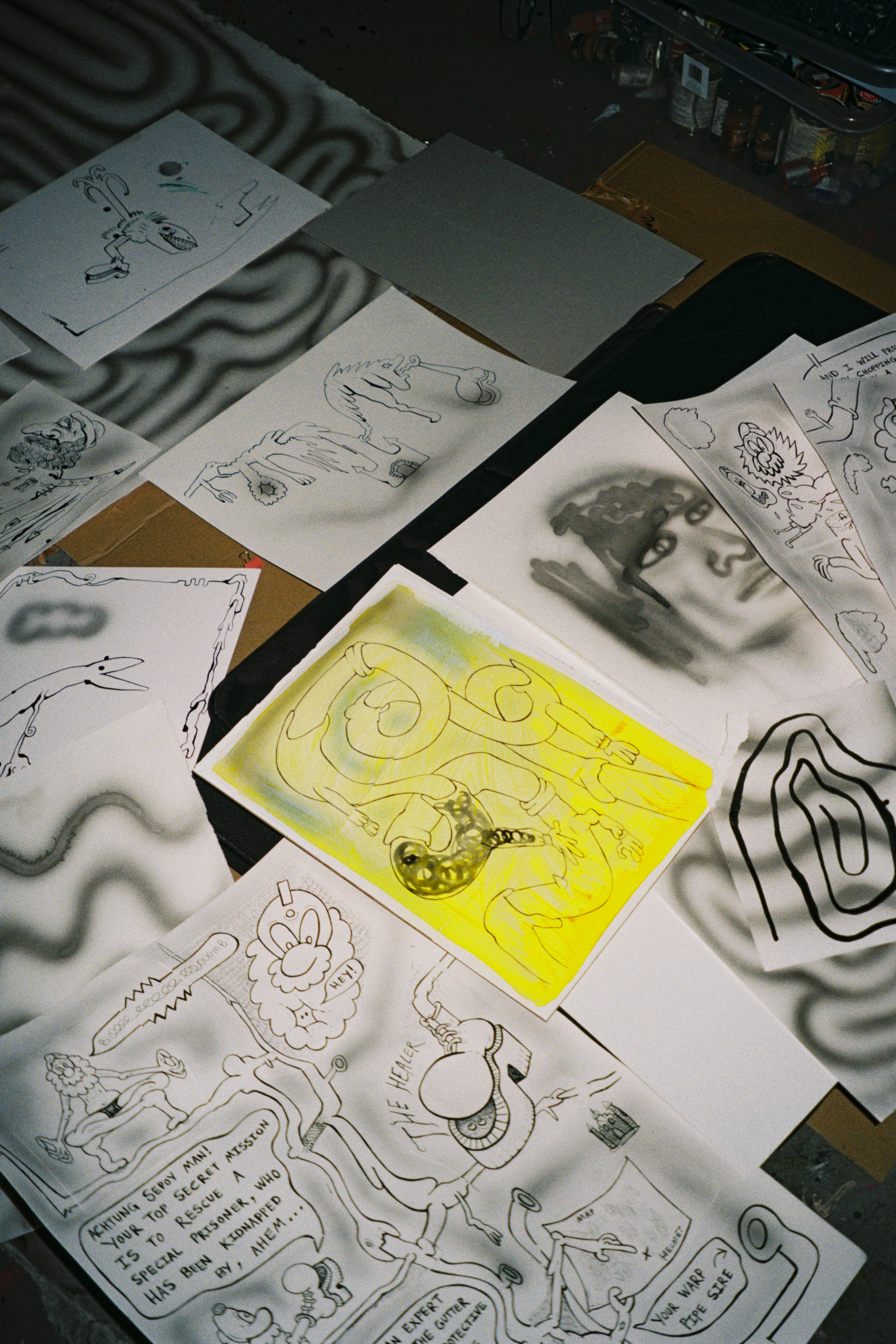
It’s a structure that can exist on a small scale but can also exist on a large scale. In my [visual] world there’s a central character that’s sort of like a shadow self. I’m calling it ‘Sepoy Man’ because Sepoys were what the British Indian soldiers were called.. But Sepoys were essentially any Indian soldier employed by the British Army. Then there are other characters which I refer to as ‘Gutter People’. This is in reference to the space in between panels in comics, which is called the gutter. So, it’s like the frames become animated, so these characters can be anything, and the images can just expand naturally in a lot of ways. But, essentially, the idea is that these Gutter People are silent, trapped, and constrained by a foggy substance which is rendered in sprayed paint. So, it becomes like a loopy thing where Sepoy Man’s trying to free them, but because it’s surrounded by the spray, it kinda gets lost in the fog. This narrative could all be imagined as a weird post traumatic response from Sepoy Man. It’s very surreal and trippy, and it allows me to also dabble in some social commentary.
[For the work at MAC] I was using massive paper. My whole studio was full. Like, I couldn’t move. Everything was on the floor, and I was moving around it. Most of the backgrounds are all sprayed directly onto canvas or paper. And then there’s little bits of text and playful things that I’m just putting in there. Some of it started on other works and then I chopped them up. So, it felt like regurgitating something, but then I think it’s connected to the idea of transformation, like the way a cartoon character might transform into another form or another incarnation in an animated way.
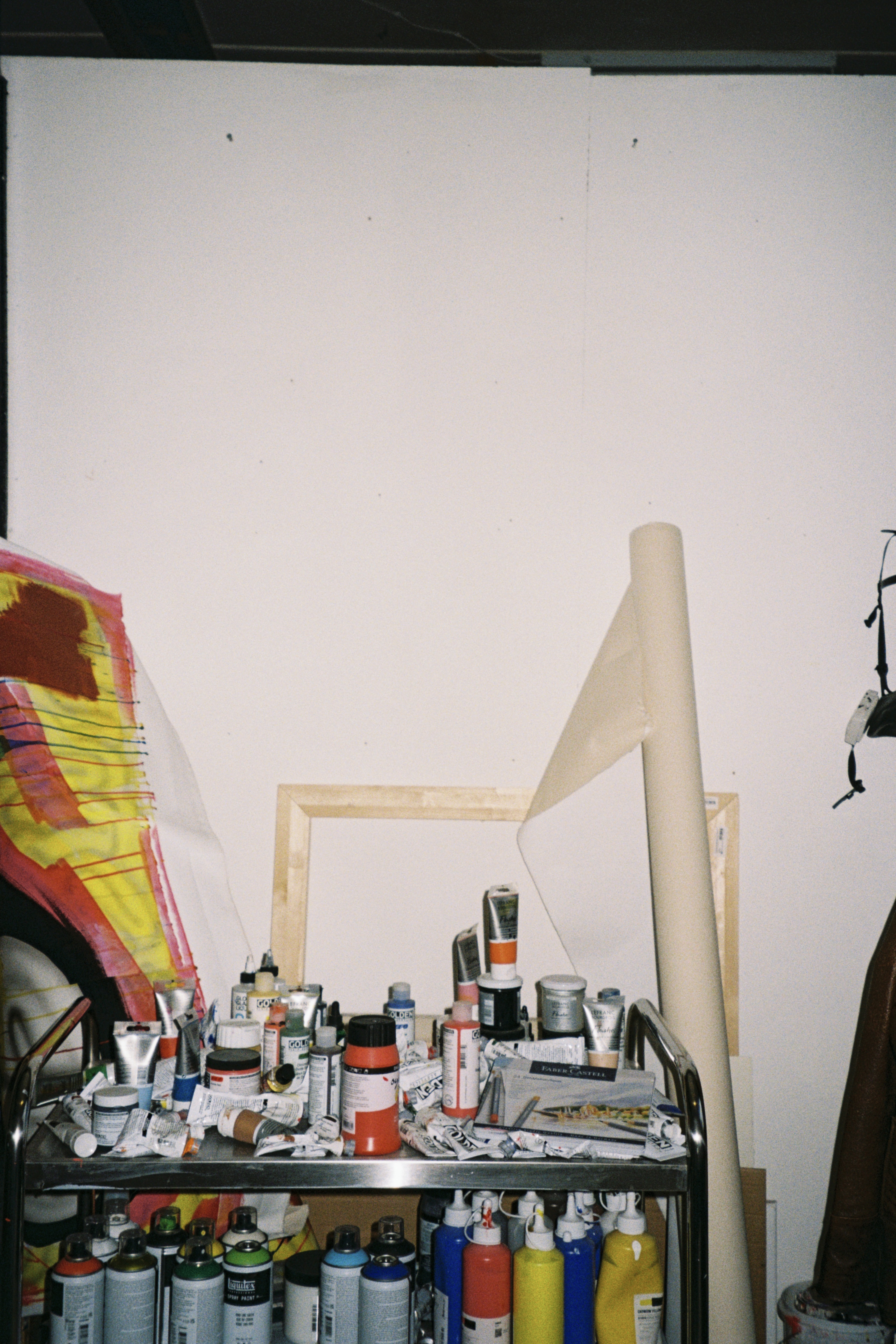
I’ve always used black, and it suggests associations with, like, graphic art, illustration, and street art, and it’s important. There’s a formal limitation or constraint that I’m taking seriously and developing along with the collage and the drawing, to push where I can go with it. I made eight new large scale works that I called the Gut Reaction series. I’ve never done anything like that. I’ve made the odd canvas here and there over the last couple of years, but this series, as a kind of cohesive sequence, has allowed me to experiment, but also present work formally as painting, or assemblage painting, whatever you wanna call it. That is new for me.
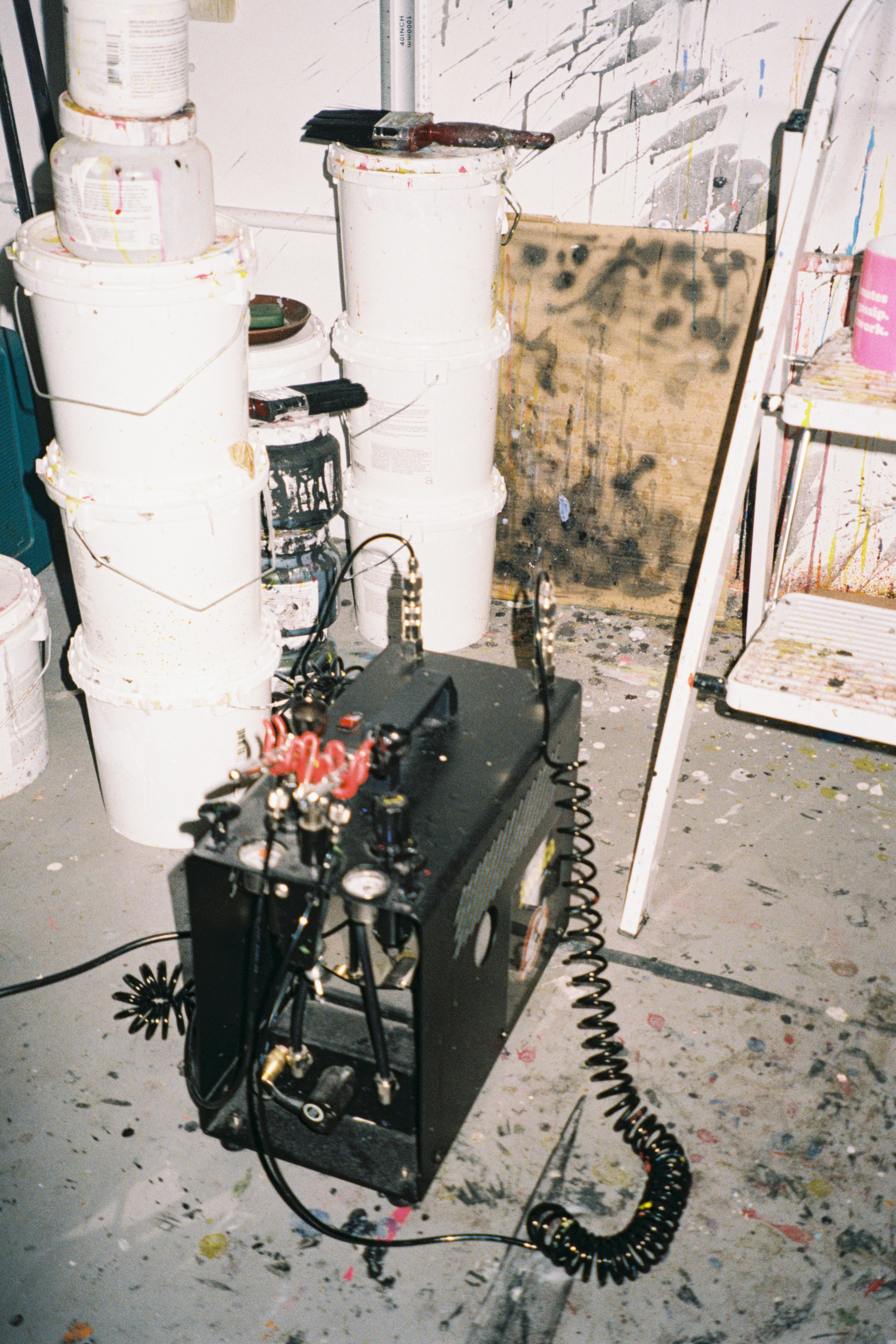
I’m using an airbrush. It’s a bit more controlled than spray paint, so I quite like that. Working with the airbrush is kind of funny because it’s like, I still don’t really know how it works. That compressor is, like, kind of a mystery to me as well. So, it’s like you are removed from the process. When I put the mask on, I feel that I’m now in this world. So it’s like a bit of a performance, you know? It removes yourself from reality and you take it seriously. I always liked airbrush stuff. No matter how good you are, it always just looks a bit off. Funny. Like, even if I try to be serious, it’s just gonna have a quality of humour that works for what I’m trying to do. You don’t wanna be restricted, but then you also gotta take responsibility.
Having this newer series and new works be in a comic format, and this highly stylised character, do you think that helps with the fact that the subject matter itself is quite vulnerable?
Yeah. I think it does. I think it simultaneously protects but also exposes. It’s hard to tell which is happening at whatever point, but it does both at the same time equally well. And I think that’s why it’s sustainable, and that’s why I keep doing it because it’s like a push and pull thing, isn’t it? It’s perfect. Once you figure out what that is in your work, then you just keep doing it because they fight, you know, it’s tension.
___
In the Studio is a new monthly series, interviewing Scotland-based artists and curators in their studios, conducted by Chaz Scott, a curator and art historian based between Baltimore, Maryland and Glasgow, Scotland.