
In the Studio
In The Studio: Jamie Fitzpatrick
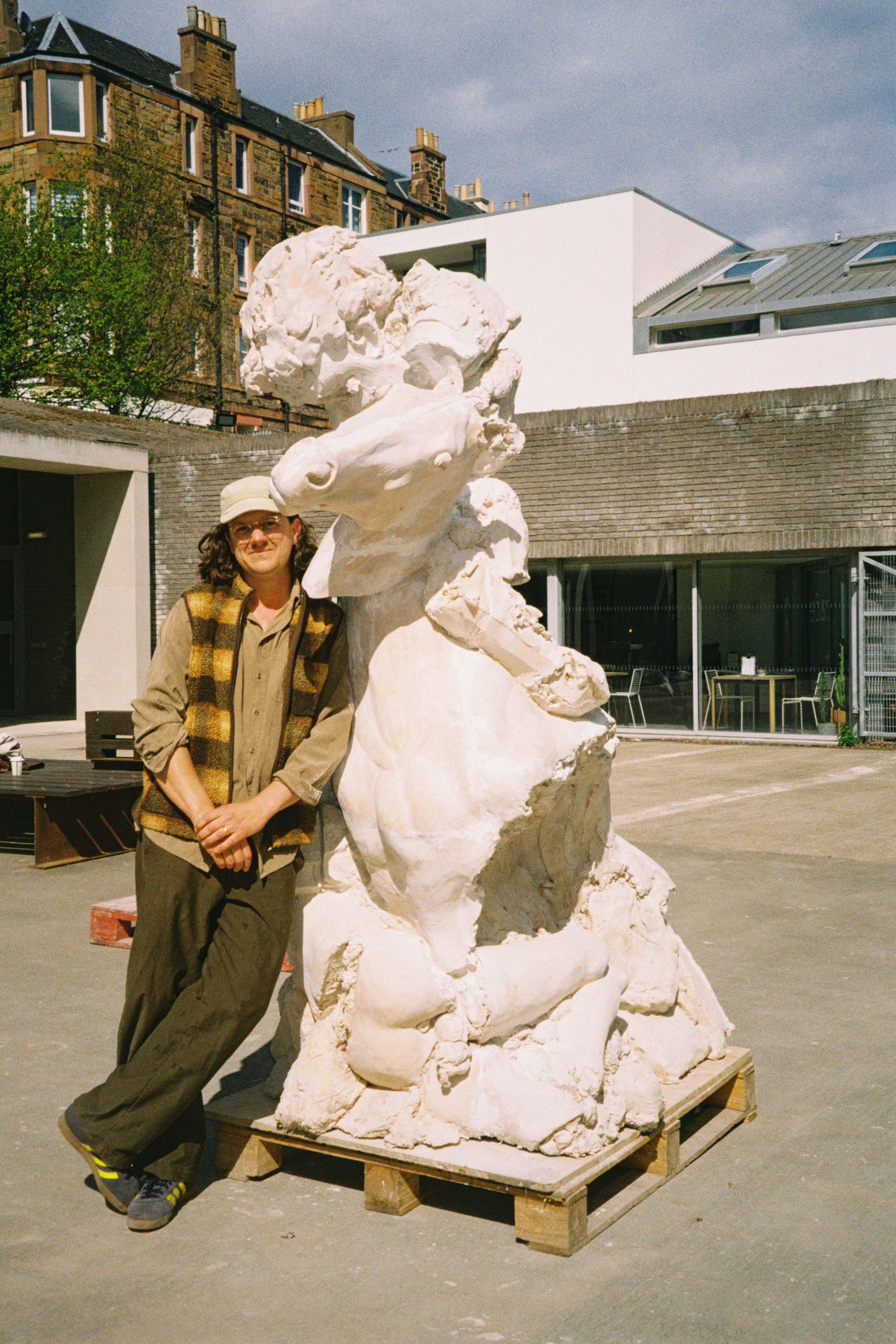
Jamie Fitzpatrick (b. Southport, England) is a sculptor based in Edinburgh. His work addresses themes relating to privilege, ‘Britishness’, and memorialisation through the use of statuary, painting, and, more recently, printmaking. Currently, Fitzpatrick’s work ‘National Theater’ can be seen at Kunstall Trondheim in Norway until the 27th of November. ‘Memorials to Sausage Politics’ is on view at Edinburgh Printmakers, as part of Edinburgh Art Festival, until the 25th of October.
How has your work changed, if at all, with access to the larger space at Edinburgh Sculpture Workshop? Were the large scale sculptures something that you would have been doing regardless of space.
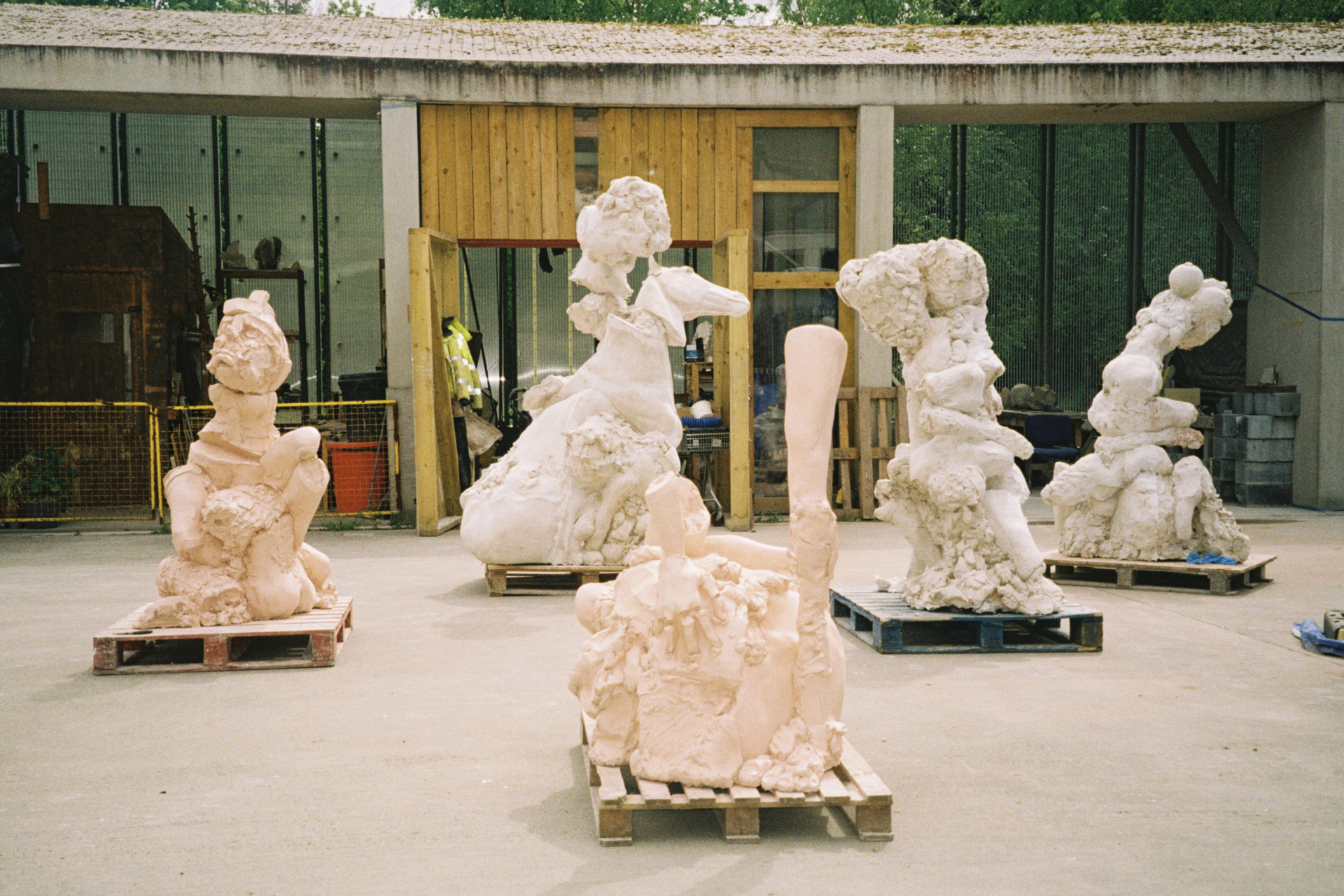
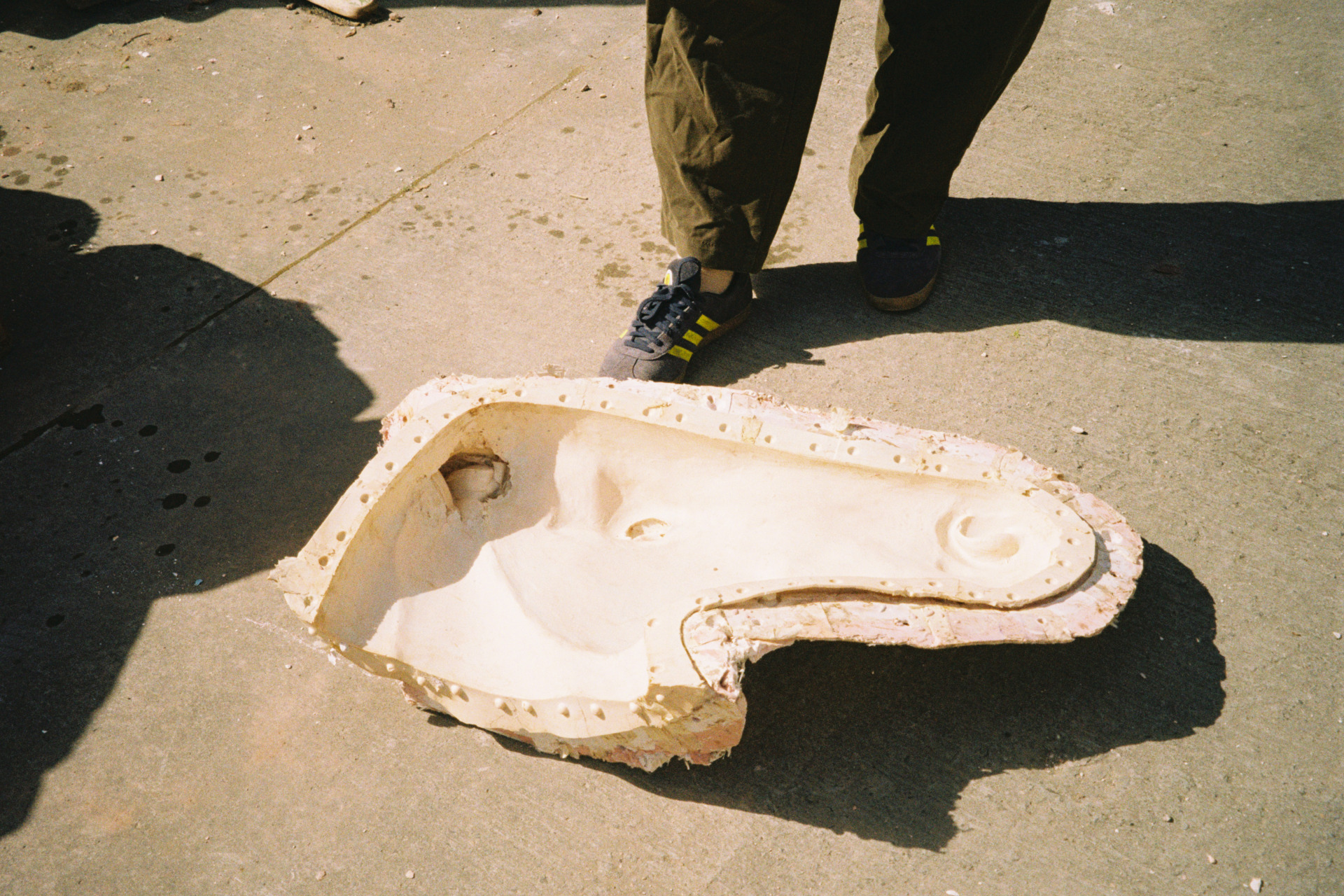
It’s changed. I mean, scale is just simply the biggest thing. When I have been making this work in other spaces, I’m limited to, and conscious of things like the infrastructure of a place and its restrictions. I have to fit through doorways. The load bearing of floors is different. Whereas Edinburgh Sculpture Workshop is a space built to accommodate sculpture and so everything is in place. When this horse sculpture here was in the mold, when you’ve got the weight of the mold and that, you’re looking at the thing being sort of close to, not weighted, I would guess sort of in the region of 300 to 400 odd kilos. We’ve got a forklift truck here that means picking that up is a piece of piss. Whereas, when you’re not in a space where you have access to those sorts of things, you have to make decisions early on that compromise that ability. So that’s essentially what it is, is that I don’t have to compromise here the sort of direction of a work based on the logistics of the building. The building is big enough to accommodate the scope and ambition of the works in a way that other spaces aren’t. And, at the risk of sounding a bit cheesy, this place is full of people that are super passionate about sculpture.
Is there a collaborative nature around everyone’s practices just by the notion of being in this shared, open air studio space? Or does it still feel quite solitary and you have the opportunity to dip in and out of collaboration if wanted and needed?
Yeah, I’ve got someone helping me on this. They are engaged in the making of these works now in a way that is very involved with the whole process from beginning to end. So there’s definitely a sense of collaboration or working towards a goal with each other. Every lunchtime, people get together and you sit and chat and I think as well, being in the courtyard and having the works out quite a lot of the time, I have overspilled out of the areas that I’m working in. But it’s just meant that there’s something kind of communal, you know, people have seen these works and seen them develop. It has been done in the open, and so therefore, everyone here is here because there’s a specificity to their interest that is about sculpture. There’s lots of people coming at it from different angles. You’ve got different materials being used, but everyone’s got their own form of expertise and it’s just really exciting being in this place.
Sitting here looking at these now, this couldn’t have been done. I mean, it’s not hyperbolic, but I don’t think this could have been done in any other place in the country, let alone just in a studio set. This place is just the ideal place for this work to be made at the moment. And so I think it’s one of the best places for me to be making work at the moment.
Talk me through the title of your show at Edinburgh Printmakers. Previously, we’ve talked about the themes that you explore in your work, but I’m interested in hearing you describe where the term ‘sausage politics’ came from.
It’s a mix of the patriarchy in an institutional and structural sense rather than necessarily a gendered sense, but it is a gendered term. And so the sausage is there, but as well, it’s that link to, like, pork and gammon and even Orwells’ power hungry pigs sort of thing. It’s addressing certain privileges, I guess. But in a silly comic way. It’s trying to hide serious ideas and serious critique behind a sort of clownishness. And yes, it sounds like a dick joke. And it’s always a dick joke, but at the same time, it’s like a dick joke with a serious point behind it. As all dick jokes do.
Obviously.
As all good dick jokes should. Obviously. It kinda catches the attention, doesn’t it? But then actually under a bit of rigour, it’s like, oh, right. Okay. Well, at least that’s what I like to think with these things.
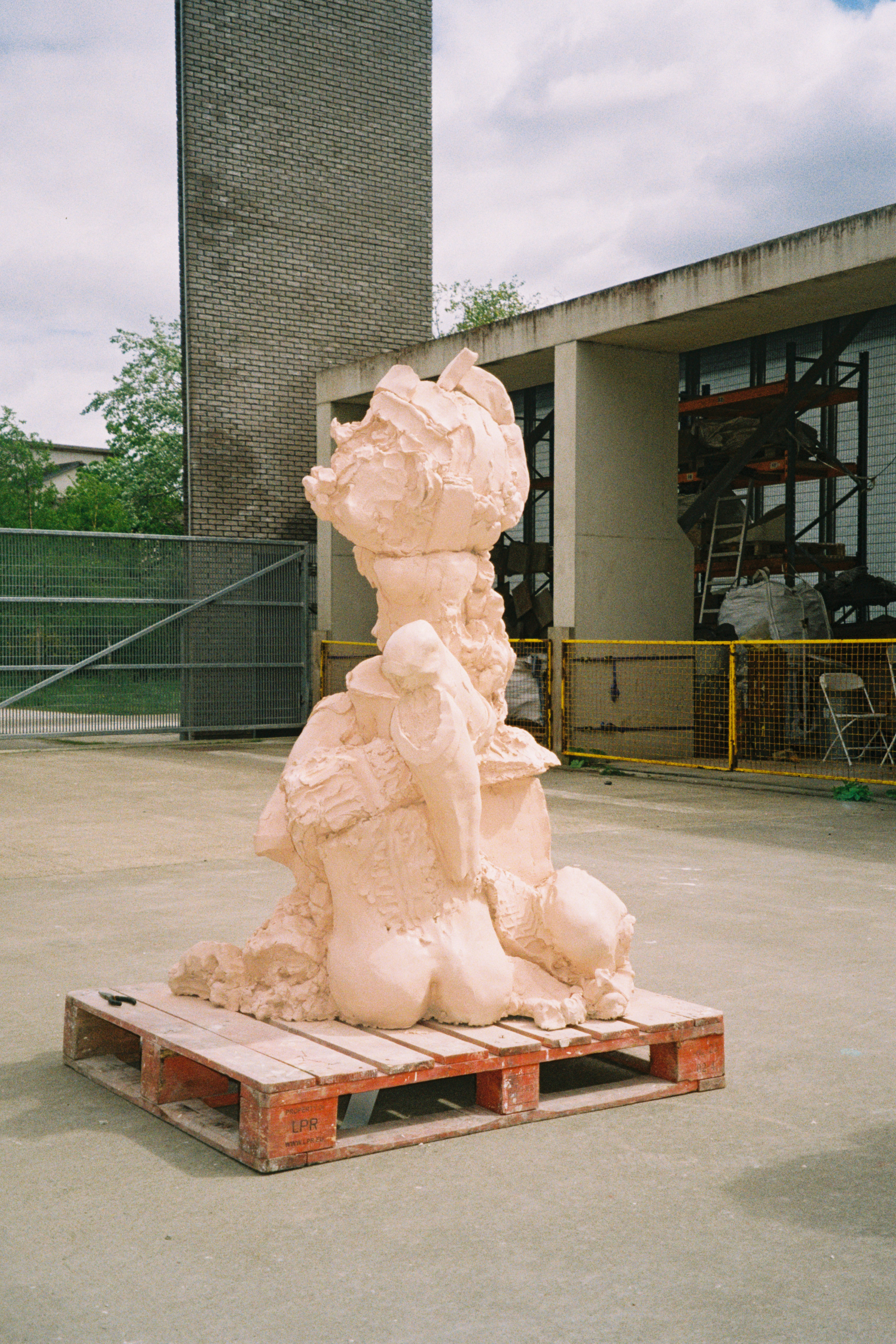
And memorialisation is in reference to a sort of reassertion of it. I’m not really interested in the body. It’s about what the rhetoric of putting something of this shape into a civic environment says. What does it say about us when we ask that the city is filled with all these things? The historical specificity of these people that someone once thought ‘we’re important enough to be immortalized in material and placed in the city centre’ in this sort of apex place. The majority of these people are lost to this sort of common knowledge. Obviously they haven’t been lost to history, but like most people aren’t walking around being like, oh, that’s that person. They did that. They did that. All they become is this amalgamation of symbols that reassert structural, hierarchical, patriarchal and class ideologies. All it’s saying is that this is what we deem important. And who is ‘we’? ‘We’ is the ruling class. They’re there to stand over you and reassert that these ideologies are deemed, by a certain section within society, as important.
This is something that I was sort of working with at the RCA, so from 2013. Then, in 2020 when that became far more foregrounded as a global conversation. I retreated away because I didn’t feel that my voice was necessarily the important one in the room at that point. I didn’t want to seem overly opportunistic like ‘actually, guys, I’ve been working on this for five years’.
I had this piece that was called ‘Memorial of Sausage Politics’ and then when we were developing the show, I put that in as a placeholder because I’d always liked it as a title of a work. And I thought it summed it up. I left it there thinking I’ll come up with something else. And in that way that a placeholder just sits there. It sits there. And after a while, the placeholder becomes the thing. It felt quite natural.
It’s nice to have a career long enough you can reference yourself.
Go through all my old GCSE notebooks.
Highlights, deepest cuts.
B sides and deep cuts.
What role does AI play in your practice? And how do you contextualise or come to terms with this use given the broader conversations about AI and its more casual uses seeping into peoples’ day to day lives?
To be honest, it’s just this one work that I’ve used AI in. I don’t think it’s going to be a facet of the practice hugely moving forward. It was just that in the context of these works, these works being the backdrop paintings, initially it was just this idea that I’d had of these people that see themselves as these self appointed defenders of Englishness. I’ve been thinking a lot about this idea of the idealised, utopian, Arcadian landscape. It’s that sort of the way in which populism is very succinct in its ideas and it creates this idea of this Arcadian place that is yours and is worth defending. But it’s not real. This green and pleasant land, this phrase of the idealised countryside of England doesn’t really exist in a meaningful sense of, like, this place that is so dangerously defended. The idea of place becomes far stronger than the reality of place. And so I was trying to think what does this place look like?
It’s basically a pretty countryside, but with the volume turned up. It’s like a multiple that folds in on itself to this point of infinity. I was trying to find ways of rendering this place and I was looking at the way AI was being used. This language model AI was being used by populist parties as a way of promotion. They were using it within their canvas. It was being used as a way of disseminating that information. It was part of that toolbox. I think all parties are using it now. But, it is the form in which this populous language is being disseminated and utilised.
It’s not that I’m really interested in AI. I’m not interested in using it as a way of filling in the gaps of creativity. I tried to use it in a way in which it was built into the critique of this idea of how these visions are weaponised in a political sense. But will I use it again? I mean, not really unless there is a way in which the use of it is built into the criticality of the work. I don’t see it as being something that I find useful. There is something quite dangerous about the way in which it’s being used but it’s not something I’m planning on using in any sort of meaningful sense moving forward. I think it was just for this work. It sort of fitted in quite nicely in the way that I was trying to communicate.
In our last conversation as well, you were talking about how you were reading through these manifestos of white nationalists and noting the way that they would describe this idyllic, Anglo world and you were using those descriptions and inputting it into AI to get these images.
Yeah. And I think what’s interesting as well. Populism and fascism and these extremes of tradition operate on the use of beauty and appealing nature.
Do you know Ballerina Farms?
No.
They’re Mormons. Ballerina Farms is their business. The wife was a ballerina. She is married to the heir of JetBlue Airlines. They have a farm where they sell meat and raw milk, protein powder, etc. There were a couple of write ups about them, two specifically that I remember last year. They’re describing their relationship and how they got together and to someone who is maybe not Mormon or familiar with Mormon traditions or not tuned in to this growing idealization of trad wife culture, it seems quite dystopian. They have eight, nine kids and counting. She gets pregnant nearly every year.
There was this one piece in the article where she was talking about how God decides when she gets pregnant. But, the way that she described it was interesting because some people took it as her purposely taking birth control without her husband knowing to prevent her from getting pregnant at certain times, stuff like that. But their Instagram and the imagery that they put out is very homesteady, cottage-core, housewife-like. Lots of photos cooking with the kids. The home is an environment for learning and growing and the kids take part in making meals with everyone and she always has a baby on her hip. The imagery itself is very beautiful and idyllic to a certain kind of person. But the idea is that they’re pushing traditional Mormon values and you become desensitised to that underlying ideology the more that you see this imagery that is meant to propagandise you.
Exactly. I always find it funny because growing up in the nineties, something like the Chapman Brothers. Right? It’s all skulls and grubby McDonald’s and all of this. And it’s been scraped out of the waste pipes. So it’s like, that’s not how fascism presents itself. Fascism presents itself as like structure and rigor and order and values. This is kind of what I find interesting. In these painted backdrops, they look pretty boring and mundane and bucolic, and then you realize that they have been formed from the literal taking of fascistic logic and rhetoric.
There’s one of them where there’s an Edwardian regatta on the British South Coast and then you realize it’s the small boats referenced from these texts about immigration. It takes these things and it presents everything as beauty. It presents it as order. It presents it as formalised and structured. The fields are all very partitioned off and it’s structural. It’s Arcadia infinite.
Last week, I read, in America, the Trump administration was proposing to revoke passports for people, maybe men specifically, but people who don’t pay child support. This idea of controlling movement and travel. It made me think of this video by this woman, Nia Ola. I remember watching where she talks about how North America is very isolated geographically. And, because of that, it would be very easy to enclose the population if they wanted to. This proposal to revoke passports for people who don’t pay child support presents us with a recurring theme that people talk about, where they make a very drastic law or propose a very drastic punishment towards a looked down upon group of people to start. You slowly think it’s acceptable towards that isolated group, and then it happens to you. That original proposal then turns into revoking passports of people who don’t pay their student loans or medical bills. And all of this is to keep a population of people sequestered to one place. What are the ramifications of that? The Build the Wall moment of Trump’s first term. It makes it difficult for people to get in, but also for you to get out. It becomes so much more clear when you think of all these other things that they’re doing, like isolating all of these other countries, raising all of these tariffs so that nothing can get in easily or affordably.
All of these figures, the reason that they’re chosen is that all of them are basically the totemic visions of Britishness or Englishness really. King Arthur, Boudicca, Britannia, Brutus, Saint George. These are Champions League level figures of English mythology. And with each of these figures, the central idea within their stories is that they staved off an immigrant threat. You know? You can see why that is so appealing to someone that has wrapped themselves up in this idea of this sort of otherness, this the threat of the other coming over, you know? We’re an island nation. It’s like we’re fucking obsessed with fucking people coming here.
Fascism doesn’t work unless it’s attractive. That’s one of the things that, with this work, is something that I’m trying to do. There’s this very fine line where it’s one thing just to go, ‘this is bad’, but also you need to hold up the beauty next to it. I’m not trying to shout about my politics. I’m trying to get people to think about their own. And you can’t do that unless you’re having both sides presented to you. So I’ve got to present the beauty and the bad.
I respect the audience enough that they have to make that decision and there will be some people and there have been people in the past who have read them as just for the beauty. And it’s not for me to be didactic about. I think it’s quite boring just to make a work where I’m using art as a soapbox. That’s not interesting. Because these things are enticing, they’re attractive as objects, you can take away all of my critical intentions and just enjoy them as large scale sculptures.
There will be people that see them as exciting monuments to British mythology, irrespective of the fact that there is a sort of critique behind there. Likewise, there will be some people that see the backdrops just as really nice paintings and landscapes. When you are presented with the models of how these have been created and are made to think about what that is, you then start to question the attractiveness of ideas. I trust the audience enough. I don’t give them everything. They have to do a bit of work too to dig it out. I say that as if it’s a subtle work. It’s not. It’s pretty blunt. But it’s blunt to the point where maybe it’s for the viewer to sharpen the edges. I give you the long low hanging fruit, but you still have to reach up and pick it yourself.
You have been working on a lot of shows leading up to and in 2026. How has the theme of your work carried on through these different exhibitions? How do you stop the work from feeling too repetitive or monotonous from show to show?
Each show has had its own theme behind it or its own direction of interrogating a different point. It’s always that idea of looking at societal and cultural structures of power. But I guess that they’ve done it from different views. One is through an ethno-nationalistic ideology and British folk history. Another one is through civic statuary and architecture. And another one of them is through an audio work that looked at an old school songbook that I had that, when I investigated, had nationalistic intentions behind it. And it was a book that was still in circulation and was there to uphold structures of cultural hierarchies related to Britishness.
All of these projects support each other on a critical level, but they’re coming at the imagery, the source material, everything is slightly different. And I guess that stops it becoming too samey. Although the sculpture is the sort of main thrust of the practice, there’s music, there’s sound, there’s painting, that, you know, there’s other aspects of the practice. It feels like there’s quite a distinct nature to each of the shows. There hasn’t felt like there’s too much bleeding across the lanes, which I think has also just been helpful for me in terms of, like these quite clear ideas.
I’ve had, for three of the projects, three separate notebooks that I’ve been working in. Early on, it was quite clear that these things needed to be separated. If I worked in one homogenous way, it was going to get quite muddy. And so I’ve been quite clear on separating them out across the last year or so since I’ve been working on them. That’s helped keep an identity to each show.
In what ways do your paintings and drawings accompany your sculptural practice? Does one serve as a draft for the other? Do you see them as two completely separate works and entities from each other?
The print, so that came out of a residency I did at the printmakers a couple of years ago, two or three years ago maybe. Probably more. 2022.
That was pretty straight up. So the way that I’ve always made sculpture is that I will start with just printing off lots of imagery. Just tons of everything that’s been in my head, I’ll print it off, I cut it out, and I start making collages out of it. And, you know, that’s why they’ve got these sort of jaggedy, broken sort of things because they’ve been built in that way. These were really cheap prints and they would just get disposed of because they were functional. They weren’t really drawings. And then there was this idea of, actually, there’s something there that is worth drawing out. And so it was about using printmaking and screen printing to sort of make these into things that would have a bit more value, not in a monetary way, but that they were just a bit nicer as works. And so the printmaker show is sort of a continuation of that and the prints on the wall will be screen printed, cut up, and collaged.
I use printmaking in a really inefficient way. I basically make one print. It’s much more like using print to collage and make a painting rather than using it as print. Early on ,when I was experimenting, I tried to make the collages in Photoshop and do multiple prints and they totally lacked that immediacy.
For this show, the sculptures are trying to show the continuation of using printmaking to develop the idea that then turns into the sculpture. So two of the sculptures will be two of the prints rendered up.
But it doesn’t always work like that?
It doesn’t always work like that but it tends to. Usually they are just cheap photocopies and they’ll get binned. They won’t be turned into works. But I think there’s something in printmaking and the idea of sculpture and printmaking being the two art forms that are most associated with ideas of ideological propaganda.
Sculpture has at its roots in quite an authoritarian tradition behind it, you know. It’s an object of authority. And likewise, the print in a much more disposable way, it’s a way of propagating ideology, isn’t it? The world changed when print was able to do that. And so I guess that there is that link in the show. I’m embodying little bits of print into the sculptures in a way that I wouldn’t normally do with other works. But it’s still very much looking at how that works.
What determines your colour palette? How do you decide whether to paint something or leave as is or have it as one monochrome colour?
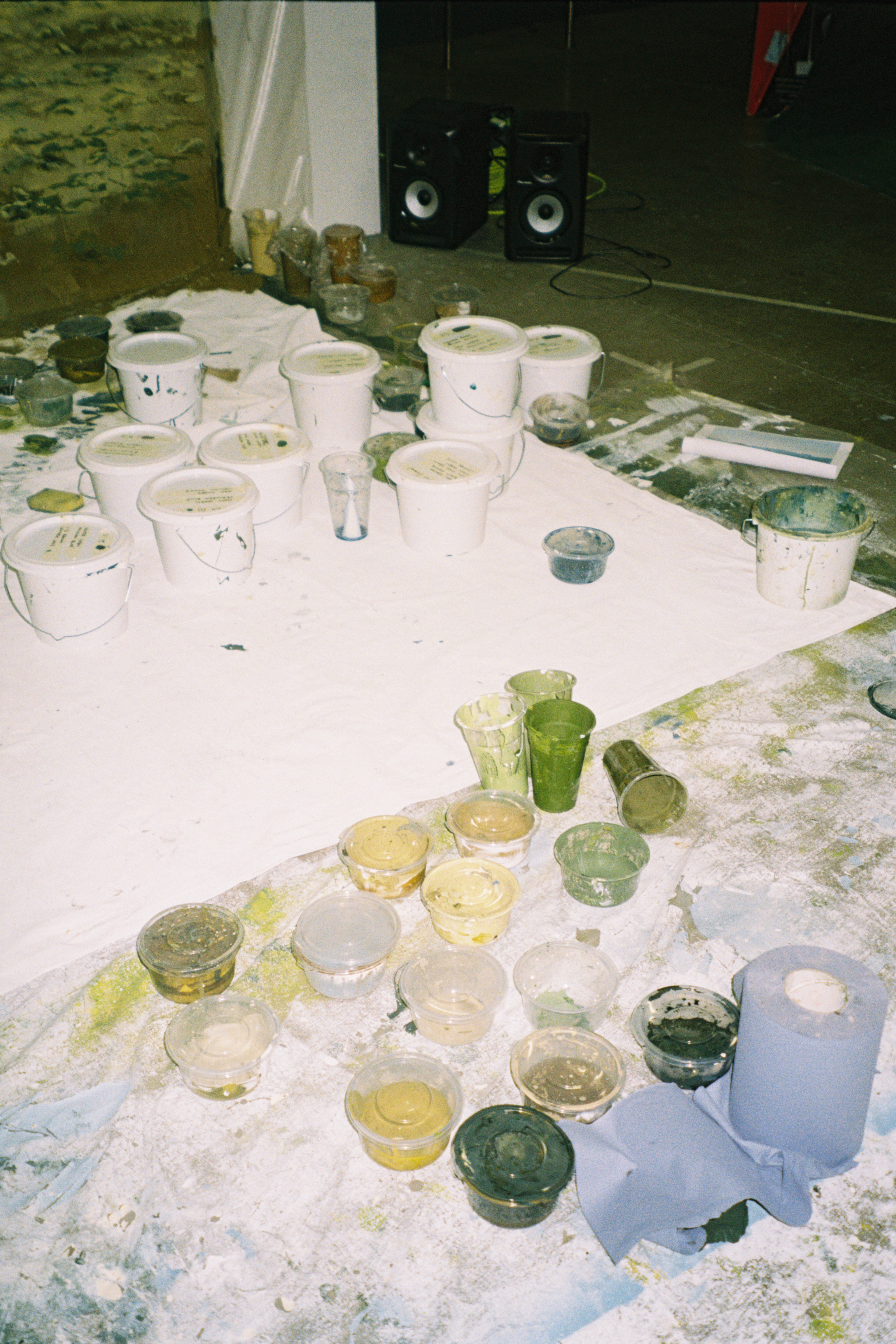
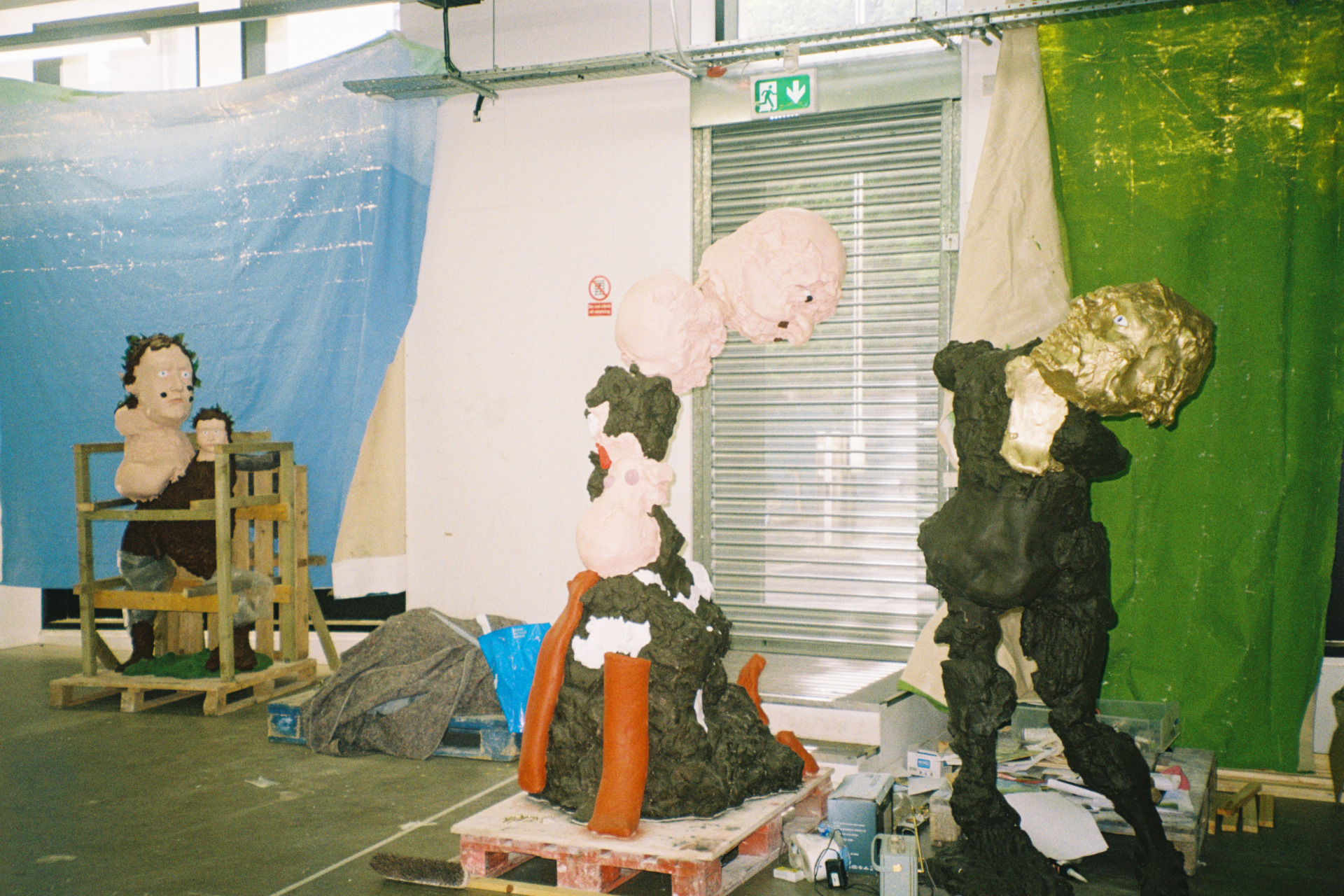
It’s pretty bad. It’s done pretty last minute. I wait until the sculpture’s out. In the past, I’ve painted the sculptures up. So the early sculptures were really colourful and they would sometimes correspond to the object that they were. So they looked a bit coloured in. As I’ve scaled up, I’ve sort of felt like the more that I use colour, the less they read as objects. And for me, the surface of the work and that sort of tension between this violence in the making and then this sort of, you know, that there are sort of parts that are refined, there are parts that are that are lovingly detailed, there are parts that are far more aggressive and that trace of making and there’s big hand swipes or boots in there. It’s this idea about the beauty and the violence being held up all as one.
When something is just one colour, you read it far more sculpturally and you focus on the surface of the work more than you do maybe when it’s coloured in. So with these ones, I took a skin reading, a tonal reading of my skin. And again, it’s that sort of ethno-nationalistic sort of, pink marble.
The whole idea is that these figures that these myths are based on are used as a sort of gotcha, like I can trace my family back. You know what I mean? It’s this idea of an indigenous superiority that people have. You never see Saint George tatted on anything but pink skin.
These figures are beloved because they seem to hark back to a tradition of preservation of Englishness. And so it felt like they’re going to have to be in a colour. Again, it’s sort of the low hanging fruit. Once you realise, oh, yeah, that’s what he’s done, it’s sort of a bit fairly obvious. But at the same time, without that explanation, it’s like there’s just a really nice color to see sculpture in. And this idea of it being both beautiful and really sinister and horrible at the same time.
Talk me through just the process of making these large scale sculptures? We’ve talked about the way that collage plays into it. But when you’re actually starting on the sculpture, what is the process?
I make a rough form out of old bits of polystyrene that I’ve got basically. And some of them are from an old polystyrene mannequin. Some of them are just lumps of polystyrene, like bits of old expanding foam. I literally get a rough shape in and that’ll be where I start. I’m mostly looking back to those drawings and collages. And then I just start sculpting over them.
I’m not really interested hugely in leaving the mannequin exposed, but then there are bits that you can see in some of them. Like the polystyrene’s been cast and it just looks like a block of polystyrene that’s been painted. So there are bits that are exposed. Then I’ll sculpt in clay over that so that the whole thing will generally be covered in clay. And when I say sculpt, we’re using a loose term. Sometimes it is just a lump of clay. Then I’ll take a cast of that. We’re talking about big old casts. And then the material which is basically a type of concrete is painted on the inside and then it’s put together like a big old jig saw essentially and then reconstituted. So these casts are hollow. They’re probably only about like an inch thick. And then they’re just painted up. I say that as if it’s just bang bang bang. It’s pretty time consuming. But it’s essentially just build it, take it apart, build it again.
How long would you say? Like a month? Like three months?
I would say to get this amount of work made in November is sort of breakneck speed. And I’ve had help. I’ve not been on my own doing this. I think to do this in the amount of time it’s been done, it’s sort of ludicrous. I wouldn’t normally work at this speed. But it’s a pretty lengthy process. I think you would normally give yourself a good year to sort of do something on scale. But I was very lucky. I got a bit of Creative Scotland funding that enabled me to access help and access materials and processes that speed things up. Because of that, we were able to get everything done in time. But, generally, it’s pretty full on.
I think one of the things I’ve learned from this year is calendar management. It’s maybe something I need to have a bit more focus on. But it’s that thing, isn’t it? Like, when they come in, no one’s saying no to an opportunity. And when they go, this is the slot we’ve got you for, it’s like, it’s only three weeks between that and the other one. You’re not going to go, do you know what? Actually, I might not do this show. You just make it work.
—
In the Studio is a monthly series interviewing Scotland-based artists and curators in their studios, conducted by Chaz Scott, a curator and art historian based between Baltimore, Maryland and Glasgow, Scotland.