
In the Studio
In the Studio: Reed Hexamer
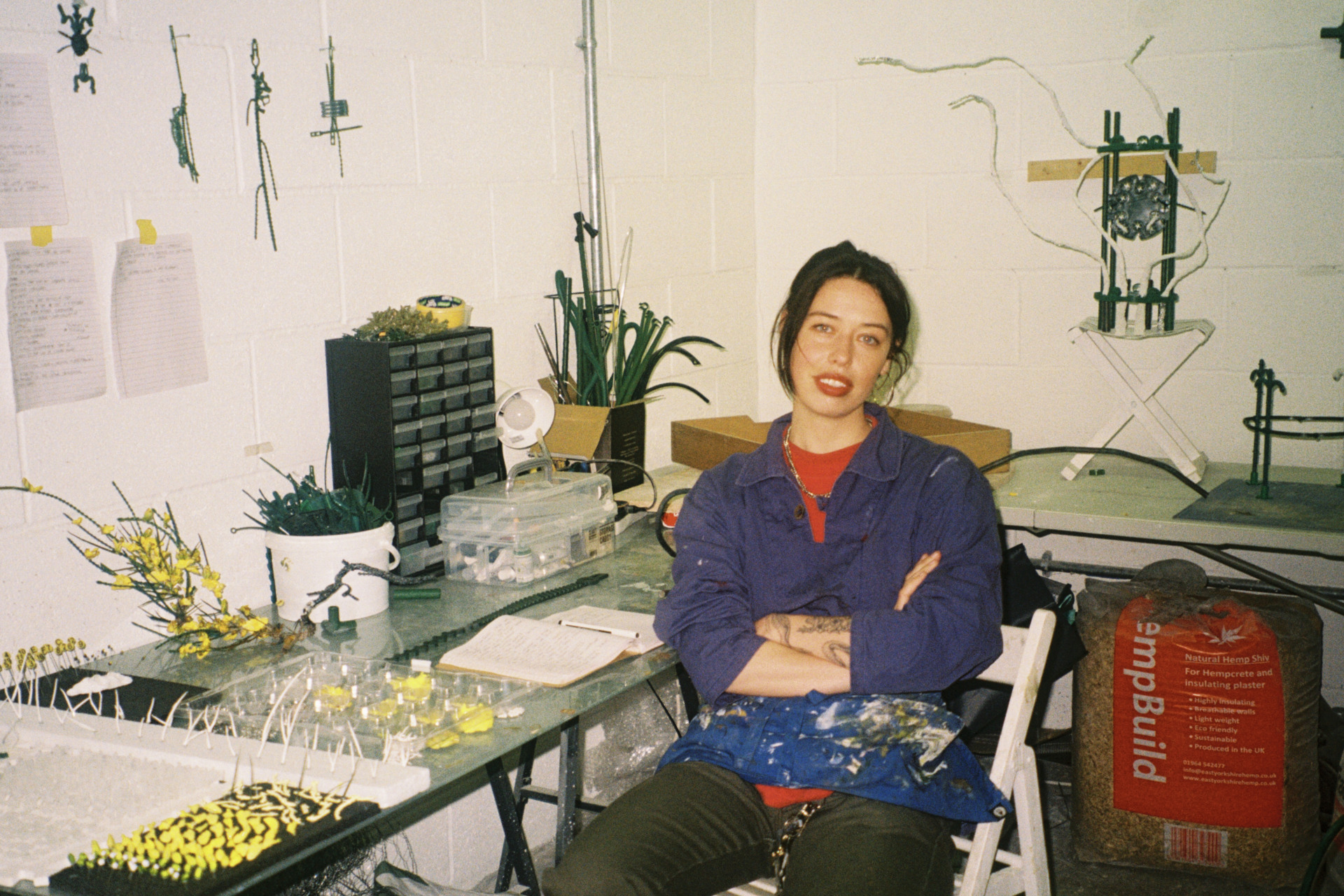
Reed Hexamer (b. Massachusetts, USA) is a multidisciplinary artist and researcher living and working in Glasgow. Their practice includes sculpture, performance, sound and film to span themes of queerness, epistemology, humor, morality and postnaturalism. Hexamer recently completed the Graduate Residency at Hospitalfield, and was awarded the Glasgow Sculpture Studios MFA Graduate Fellowship. Hexamer will present a solo exhibition at Boardroom Committee Room in November 2026.
___
Your work often begins with looking at archives and scientific records, specifically in relation to human and non-human relationships to land. What threads of research are folding into the work that you’re currently making?
Research and archives are a really big part of the work, but I also just think that they’re a big part of what I’m interested in as a person. I have all of these kinds of different, temporal threads of research that sort of sprawl outwards and then as the work is made they unwind like an old ratty sweater. But it’s funny because I just went to the IRAAR (International ReseArch group on quArries and Rock-cut sites) conference. I’m particularly interested in quarry archaeology because of how difficult they are to date and all the ways quarries themselves can resist interpretation. Often times ancient quarries are the site of modern quarrying as well, so it’s another place where these different groups of people with different phenomenological relationships to the land, and to the rock are being overlaid on top of each other, this act of quarrying completely destroys the paleosols and eradicates archaeological evidence. With quarries, what you’re working with is a subtraction of material. Archaeology is always going to be about inferring from traces, but in the study of quarries, you’re often working with what is not there. You’re working with evidence of erasure and you’re continuously working with a literal void and you can’t carbon date a void.
I’ve also been thinking of conglomerate rock as a metaphor for my approach to research. I do a lot of reading and absorbing all of these different modes of research, whether it’s six hour phone calls with friends who are really into these different sort of worlds of research, or whether it’s somatic research or making based research or it’s books or lectures or conferences like this one, they coalesce and they create this strange substrate that has all of these veins and occlusions. The work emerges from cutting away at that conglomerate and seeing where there’s friction or where my cluster of research resists the making.
Your degree show for the MFA included some sculptural work about gorse and you’ve been continuing these explorations since graduating. Can you talk to me a bit more about this work and your research and interest in this plant?
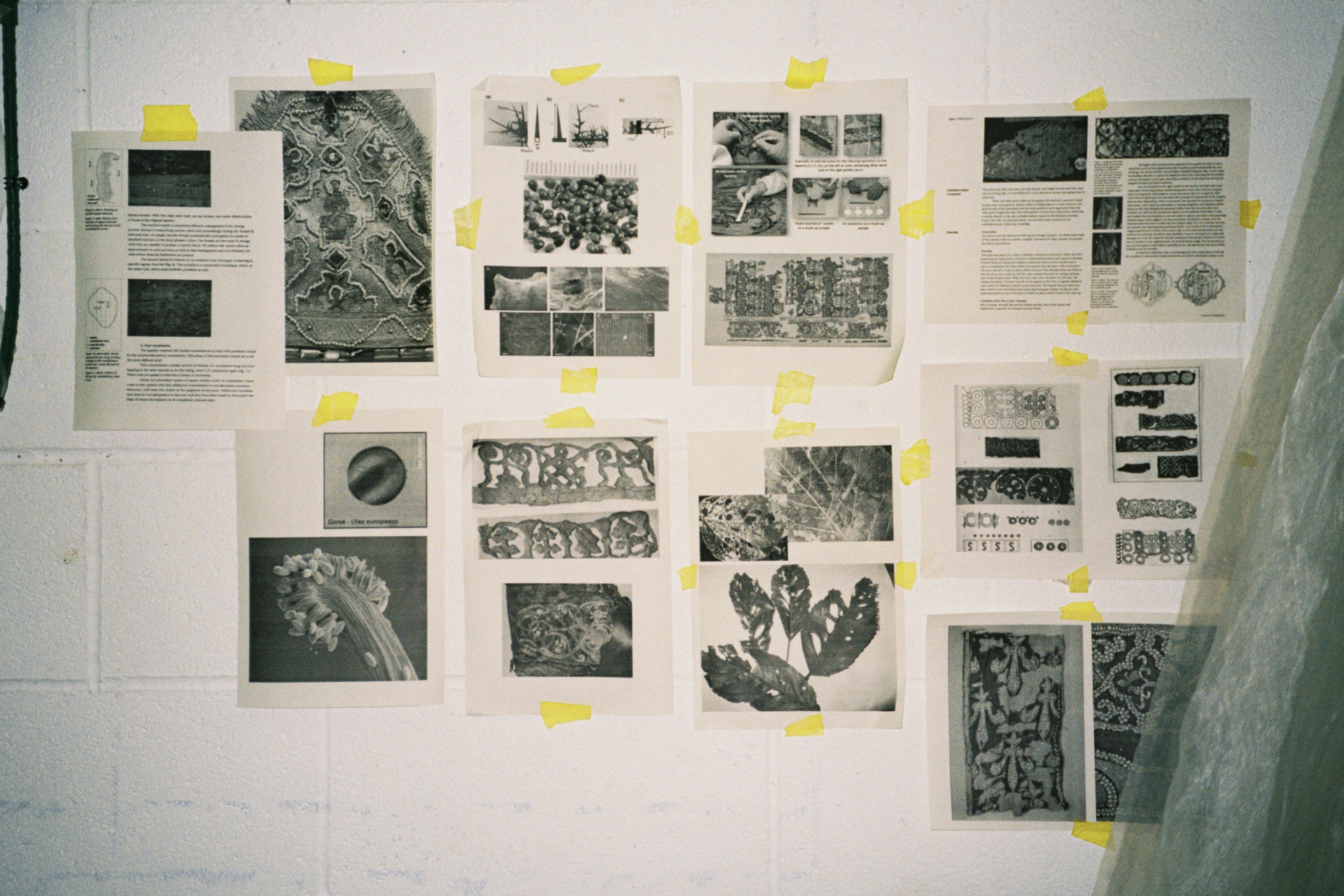
I’ve been really interested in gorse seed dormancy and plants that are germinated by fire. I’m imagining this combination of half awareness and violent rupture as this place where all these different cosmologies can meet in a lucid dream. I’ve been collecting traces of research that include interviews with biologists, medieval writings that describe gorse’s role in an economic and agricultural systems, notes from town meetings that refer to gorse clearings, archaeological surveys that describe mislabeled gorse mills, online gorse hate forums. Woven through all of these will be elements of the personal, the autobiographical, but often through an unreliable or shifting narrator. I’m also thinking a lot about visual, chronological legacies and unseating that chronology through these horticultural fleece tapestries. Also maybe not necessarily relics themselves, but the economic and the political systems that relics gain and retain and distribute power through. Gorse has been a really great collaborator to explore these shifting ideas about territory, truth, boundary and morality.
In my sculptural practice, I’m thinking a lot about apotropaic sculpture, that is, sculptures that aren’t intended for a human audience. That word itself is also interesting because it refers to a turning away or turning your back. I’ve been thinking of apotropaic sculpture as a queer methodology, something that’s accessible to practitioners that traverse these borders of morality, and apotropaic sculpture in a world where conceptions of the human are unevenly applied. That gaze also serves as part of an encoding process of the work. I’m looking at gargoyles and grotesques, particularly how written accounts of gargoyles and grotesques have shifted over time.
My work isn’t really interested in being educational and isn’t necessarily interested in chronological narrative or complete interpretation. And so it is funny to be pulling in so many different sources of information, but also to not be particularly interested in the display of information. I think a lot of my work is really interested in snagging at and perforating these archives and the boundaries between legitimate and illegitimate research and who decides the way that research is interpreted, who decides the framings, who decides on chronology and narrative. So, yeah, I’ve also just kinda always been nerding out.
You are someone who’s very interested and engaged with archaeology, geology, and the replication of natural material. When did your interest in these topics begin?
I’ve always been really interested in trying to find these queer counter-teleological ways of telling a story or refusing to tell a story. I think that this sort of replication also really connects to my experience working in set design, prop making, and scenic painting. Even working in a flower factory for a period of time. A lot of this work is bringing me back to when I used to be the person who would count out bundles of ten peonies for fifteen hours.
There’s an obsessive rhythm that I’ve always had for as long as I can remember. But I think the work started to change when I started to embrace that as a choreography that’s specific to the work. The replication is also connected to this watcher, observer place that I make work from, which requires being in this liminal, border-like place. That emerges, for me, really naturally from a place of transness, from a place of transience – transience has really marked my experience forever. I’m interested in where replication snags and misses, and in replication as a method to reveal slippage. The continual failure and non-completion of that kind of ritual that is also quite physical and becomes a repetitive, somatic rhythm as well. I’ve always been interested in how biological knowledge is produced and how conceptions of nature are produced. A lot of the work that I’m wrapping up now was about how these categories are produced and the dust and residue that settles on fact. I’m more interested in thinking as a process or thinking as an entity that can be engaged with. These different materials or these different subjects are collaborators that I can work with to reveal the way that the thinking around them is structured.
I’ve been engaging with strange gardening materials that themselves embrace this idea of capital ‘N’ nature, capital ‘R’ romantic nature, but consistently miss. I’m obsessed with these orchid clips that are the most horrific, repulsive shade of “Nature Green”, that have daisies on them but they’re for orchids. And these grafting clips and greenhouse frame connectors that will have these strange squiggles that are supposed to evoke “Nature”, but they just fail and break apart and break down in these really interesting ways. These weird slippages and misses. All of these cages and these strange materials are structuring everyday people’s biological knowledge and interpretation of how plants grow when these things are actually incredibly controlled by these technologies of control.
I’ve grown up seeing a lot of these because my mom’s a Gardener, which is also very present in the work. But she’s a hustler gardener and so it’s funny to have this relationship with nature and the “natural world” where I can observe these moments of beauty and the spiritual, but also see the way that my mom is cutting up moss in a public park to resell. All of the tricky ways that you can make flowers open and make flowers close, and make them stand up how you want and the implications of that. Seeing beauty used as a tool, a gendered tool and all the ways that gender and labor intertwine in that industry. It’s made me quite critical of nature and beauty as constructed enforced categories. It made me really interested in seeing how all of these things entangle with teleological, imperial approaches to knowledge that are really like these collaborative processes of fact-making.
How much research are you doing in conjunction with physically making your work and what does that process look like?
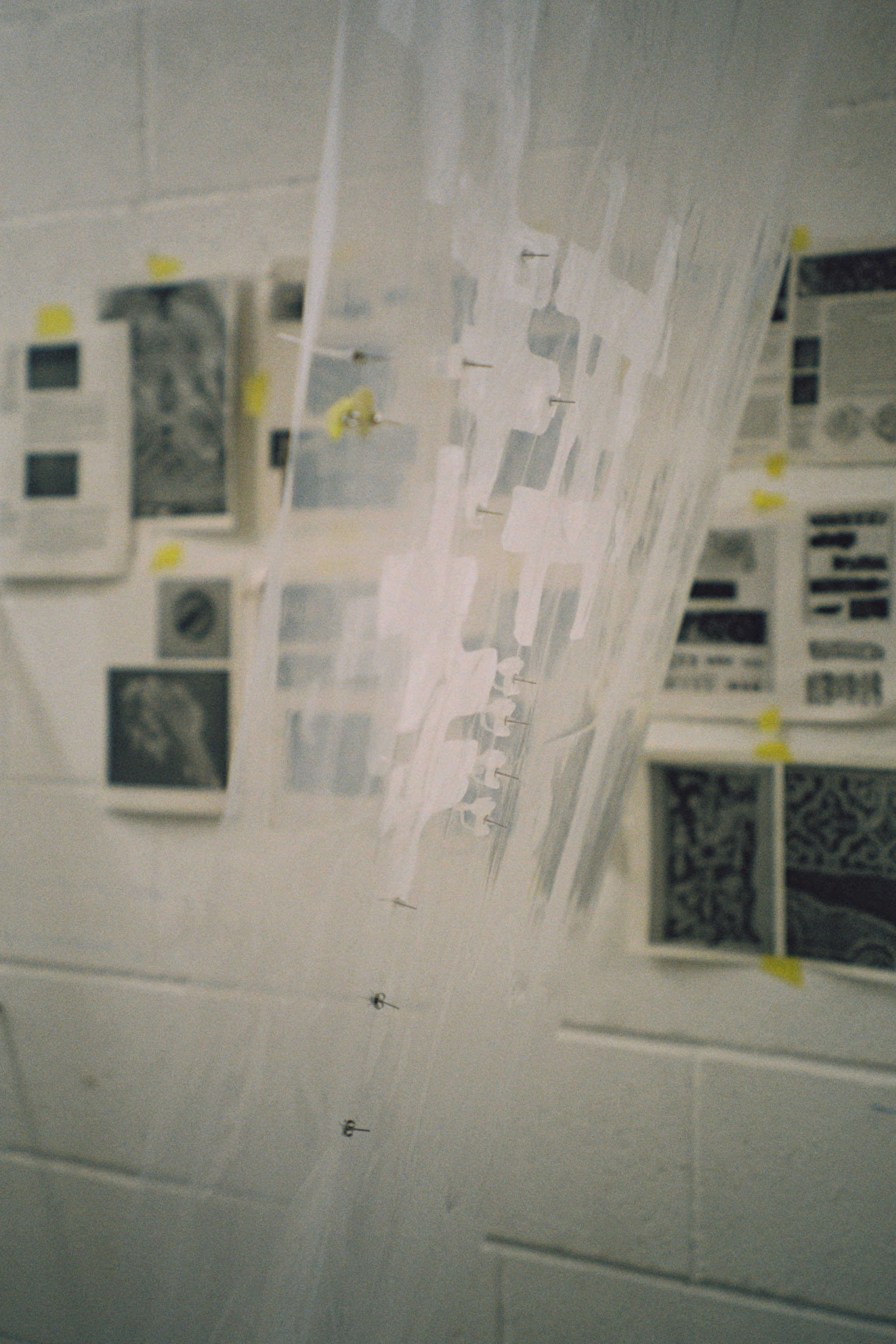
The kind of research that’s led by the making is quite different. The making allows this really special space where all of the dust that’s kicked up by the research can settle. And I do a lot of really physically intensive repetitive making that is also about this gesture that opens up a space where different threads of research and all these different temporalities can layer on top of each other and intermingle and cruise and argue with each other and hang out. Ironically, part of my work is also challenging my own insatiable desire to know, which has been something that I’ve always dealt with, and am thinking about different, more errant ways to encounter. There’s this really great talk I was listening to by Katherine McKittrick where she talks about holding onto and releasing history. I feel like that’s my relationship to research and, particularly, what has been recognised through imperial logics as valid forms of research. The “objective sciences” and things like that. I really like holding on to research, and not positioning yourself as against these forms, but, instead, allowing yourself to walk by them with a shoulder graze and encountering outside of a framework of mastery and domination.
Oftentimes it will be in these really repetitive processes of making and creating an archive and library of a ton of smaller sculptures that then get used a second time and a third time and a fourth time, where things actually click in and come into focus. I’m trying to open up a lot more space in the practice right now for that kind of time. Then that becomes its own encoding process, which is something that I think about a lot, this process of layering and encoding, but also resisting chronology as the dominant method of interpretation. These works feel like they become kind of imbued with the research in a more mixed up, more strange, weird, deranged way. As they get incorporated into new sculptures, these ideas become encoded and they maybe obtain some of their own agency, and how they wanna invite in or refuse or repulse. They require a strange laboratory to gain energy to do that work, and I think that’s where the making becomes really important.
You recently did the graduate residency at Hospitalfield in Arbroath. What have you taken away from the time that you spent there, and has your practice specifically changed as a direct result of that residency?
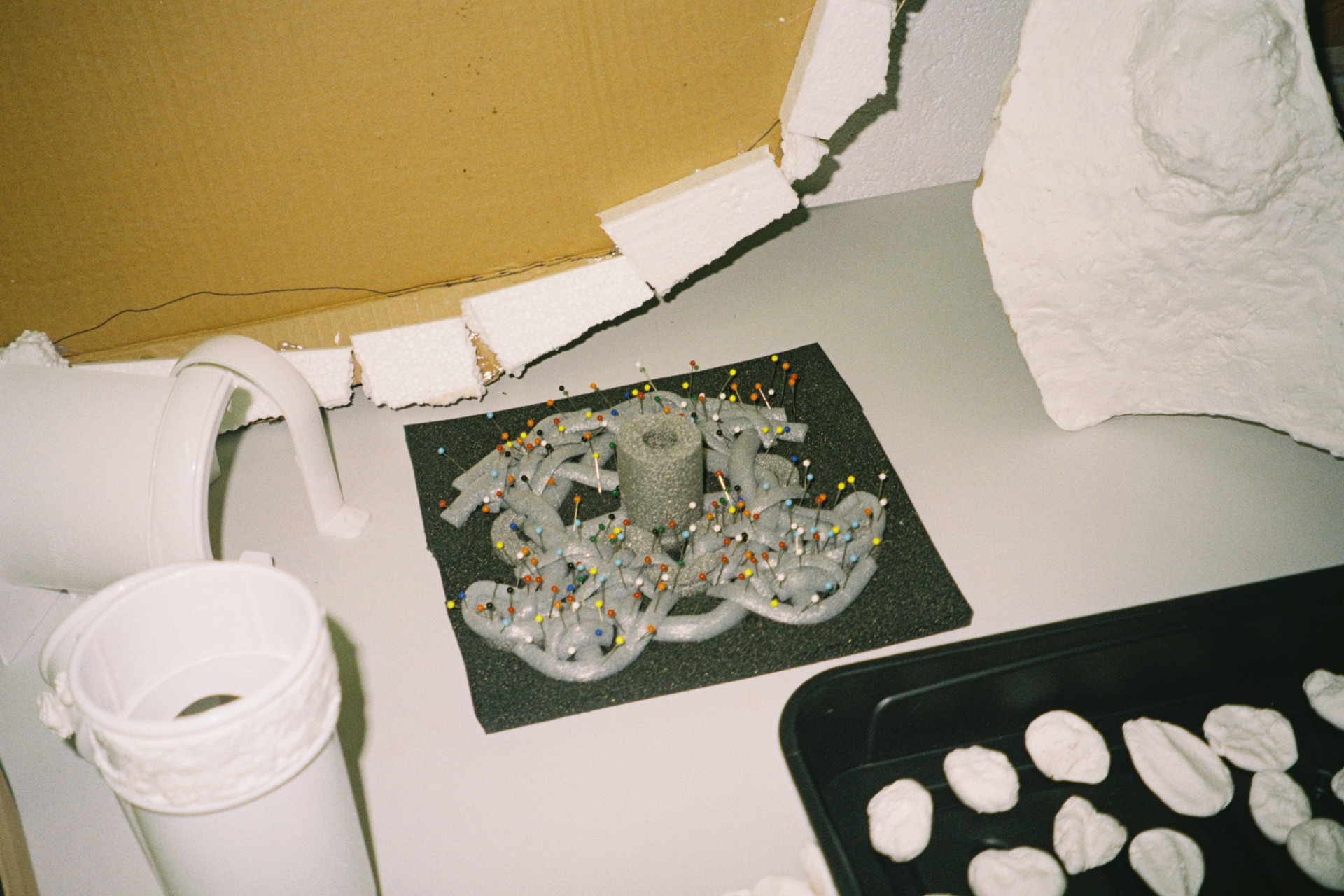
Kind of what I was just talking about with having this space to really dive into the feeling of making and this haptic sculptural practice. That was really huge for me there. I think I made eight hundred tiny sculptures with my brain sort of off and everything else really on. A lot of different things clicked into place. I spent a lot of time there actually thinking about the personal. Something new in my practice is bringing in the personal in a non-confessional way, where it’s treated as another material, like another intrusion in the conglomerate, another hard marble clast. The personal can be used to make something stranger and to make it more resistant to interpretation. In the same way that when you strike a metal tool against that conglomerate, these veins and occlusions push back, but in moments they also recede and give in.
While I was there, I was really excited to begin some threads of research that involve other mediums. I’m working on a film right now. I’m working on performance. I’m revisiting sound. It was just really nice to go and be given the luxury of time.
Speaking of space, you have your studio at Glasgow Sculpture Studios now. How has your work changed, if at all, with having this new studio post-MFA? And have you been able to experiment in any new ways or with any new methods since gaining access to the workshops and the materials and tools that come with having a studio at GSS?
This is the first studio that I’ve ever had that’s an enclosed space that’s just mine. Before my MFA, I had only ever worked in my room. And so it was me with a baking sheet on my lap in bed, making sculptures.
The nice thing about having this enclosed space is that I still get to do that work at home. It’s really important to me to have these intimate spaces where I’m living, where I’m in the habit of making work. But what that means is that now I can make more purposeful decisions about where work happens and that’s been really huge.
GSS is a place where I’m doing a lot more active thinking. I work quite small, maybe for a year, and then suddenly things erupt and grow. I’ve been able to do a lot more metalworking, which has been really fabulous and really exciting. It’s been cool to be looking at a lot of historical metalworking practices and tool making, and I’m looking right now a lot at debitages. They’re being treated with new importance in archaeological research. They’re often mounds or collections of cast off flakes and pieces of tools that are being found in archaeological sites. A lot of them are reject parts of tools, reject carvings, like the rubble that’s left after tools are produced. It’s cool to be researching that sort of thing and looking at manipulations of rock and stone and then having my own temporality being layered on top of what I’m researching. And metal’s also lots of fucking fun, I’m having a blast.
You work a lot with nature and the natural earthly material around you. Has your work changed or has your work been affected by now being in Glasgow versus in New York and how those landscapes differ in the material you would find?
It definitely has. I work based on what’s around me for sure. Like a lot of these gorse works are super site-specific, but interestingly enough, gorse is actually something that can be found in California and I’ve seen it when I was living in Oakland. It was a funny thing to be here and researching and chatting with biologists and people who work for land management companies, and also people in the pub, about this plant. It felt like a funny bridge into my time here.
Connecting back to your last question, I also think that the work has shifted a lot when it comes to space and access to space, and the kind of work that I would be making in a small apartment in New York has changed a lot. When I was in New York, I was doing a lot of writing, I was still doing a lot of reading, and a lot of scenic work. Most of my art was either something that was being produced on a film set, like concrete texture, brick texture, sky. A lot of the creative work that I was doing was to support mutual aid networks. And so it was when I moved to Glasgow that I started to carve out space for a different kind of practice. Funnily enough, I think a lot of the work that I’m making right now is actually about my time in New York, like working as a scenic, working with recreating those rock textures. I’m opening up a part of my practice that is more reflective and having the time to do this kind of repetitive work is allowing things from five years ago, ten years ago, fifteen years ago to resurface.
You do a lot of community and mutual aid work by way of making and providing meals. Can you talk to me about that and how, if at all, it blends into your art practice or how that serves as a practice of its own.
I don’t see the mutual aid work that I do or have done as part of the practice, and I don’t see them as artworks, which is not to diminish the way I feel about the work. I’m a big believer that there should be lots of things in your life that are not art, but I do think that there are these weird moments where they sort of overlay. I think that the way that I make work, it sneaks and creeps into my bedroom and into other parts of my life, and I also invite it in. My approach to mutual aid work is looking at it more as a way of moving through the world and as a sustained practice of solidarity with each other.
I’ve been in positions where I’ve needed food and I’ve also given food, and it’s been really nice to spend a lot of time working outside of a charity framework that locates people as haves and have nots. My community work comes from a great sense of joy. A lot of the community work that I’ve done is sort of cooking-related stuff. There are these funny overlaps where you’re working with community gardens and you’re working maybe with local government, but you’re also picking up fruit and vegetables or bread from a factory at three in the morning where some dudes you know said they would leave some stuff out for you, ‘but come and grab it quick’. There’s this real diversity of tactics and strategies that’s required to create these evergreen sustainable networks. My sculptural practice similarly embraces a diversity of tactics that include fugitive strategies.
It’s such a joy to get to do that kind of work. And there’s a lot of creative thinking that goes into it even if I don’t necessarily see it as art. Like having to brainstorm with people how we can deploy two hundred frozen burritos that are pre-made by volunteers that then get reheated at four or five in the morning, and how we can monitor police scanners to ensure that they get distributed to people who are leaving jails after periods of mass arrests, but also the information that you’re getting is unreliable. And so that really requires using a mixture of forms of research, honestly. I think that that shows up in the work and I also have made a lot of artwork for fundraising.
I do these food projects that are often experimental lectures that blend food or science. I just did one in New York called ‘Cabbage Stories: A Global Folk History of Agriculture and Resilience’. I worked with friends Victoria Vuono, an architect, and Angel Martinez-Lombardo, a farmer. We were tracing brassica folklore and seeing where it overlaid with recent genetic research on brassica and how viewing folklore as an agricultural technology could reveal these anxieties or these temporalities of labour, and what they could say about concerns of agrarian life and potentially resistance of those groups using this very humble vegetable as a portal. That was a fundraiser for Feed the People Bedstuy, a group I founded with friends in 2020. It provides 150-300 free meals per week for food serves, strikes, jail support, migrants, and elders.
I also have my own practice of propaganda generation. I think propaganda is a neutral tool. I have worked with poster design or social media campaigns that get out information to people about scripts that New Yorkers can use to challenge police who are removing unhoused people from subways. That’s its own tricky part of my practice that I see separate as the art –knowing how to use certain kinds of colours, certain kinds of graphics to change how something proliferates and moves. I think I generally see the two as something separate from each other. There’s politics in my work, but I see my political life as something that stands next to the work, and I think that my work has a material engagement with community that holds its hand. I think that material engagement is critical. The practice is a space for digestion, resting and scheming that unfolds in the crater of action but I try not to confuse it with the action itself. I think that my work hopes to create a less didactic space where maybe people can be oriented towards a certain politic.
The work that people might describe as political work or community work that I’ve done, I just see as part of the rhythm of life. I feel that a material engagement with each others’ conditions is a part of being human and a part of embracing relation in a way that makes every part of my life possible, including the art making. Some days these projects or these actions feel really special and intimate, and some days they just feel like getting up early and rehydrating a bunch of fucking beans. There’s something in the normalcy of that that is actually where so much of the comfort and so much of the love lives for me – in the boring automatic rhythms of solidarity. You know, I’m cooking the beans. I’m not building Rome, and I’m glad that I’m not. I’m just cooking beans often with other people and I’m happy to be cooking them and when I’m not happy to be cooking them, I’m still happy to be cooking them.
___
In the Studio is a monthly series interviewing Scotland-based artists and curators in their studios, conducted by Chaz Scott, a curator and art historian based between Baltimore, Maryland and Glasgow, Scotland.