
In the Studio
In the Studio: Tulani Hlalo
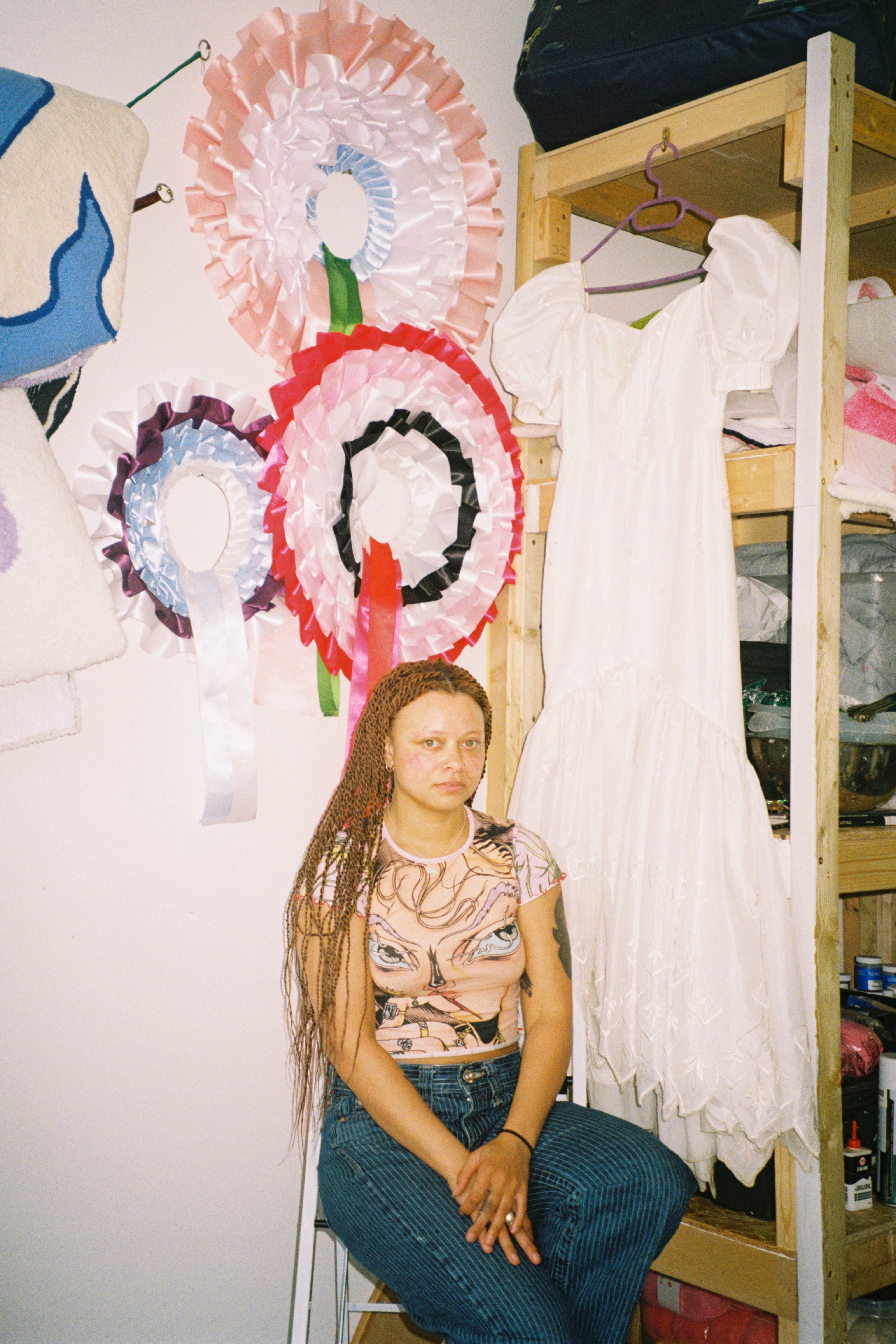
Tulani Hlalo (b. Newcastle, England) is a mixed media artist based in Glasgow. Hlalo works primarily with moving image, costuming, installation and textiles to address themes of personal identity, surrealism and humour. Her most recent series of work explores competitive dog grooming shows through the making of colourful tufted rugs that double as costumes, shown alongside video works and sculpture. Hlalo represented SOUP at Feria Material in Mexico City earlier this year, featuring similar works from her show Silly Bitch at SOUP in 2025. Hlalo currently has work presented in the Limburg Biënnale through the 23rd of August at Odapark in Venray.
How does your identity show itself in your work, and how does that work potentially look different being in a city like Glasgow versus Newcastle where you’re from?
The way that I put my identity into my work is about my dual heritage. A lot of my work about grooming is about being two things at once. I use the work as a vehicle for that. It’s quite an abstract way of doing it. Using humour is a good vehicle for that sort of thing. I’m not a particularly serious person. I’m using fun motifs as vehicles for heavier sociopolitical themes. I don’t know if being in Glasgow has sort of changed the way I go about that.
Both Glasgow and Newcastle are predominantly white cities. The context of the work isn’t that dissimilar?
Yeah, not really. I don’t think it’s fully changed. I mean even when I lived in Manchester, which was slightly more multicultural in comparison to here up to Newcastle, I don’t know. I guess it’s always been within my own bubble. It was quite hard growing up in predominantly white areas and being mixed race. Specifically being mixed race in the way that I am. I’ve not got very Eurocentric features and that kind of thing. I use the work to parse through thoughts and feelings about my own identity.
My mum’s from the Midlands in a working class mining town and my dad’s from Zimbabwe. Neither of them are from Newcastle, but they both still live in Newcastle, and that’s where I was born, that’s where I’m from. I’ve not really had any heavy linchpins to the place that I’ve grown up, even though I am from there. I’ve been to Zimbabwe a few times. I don’t go that often. Every time I do go, I feel slightly more engrained in that. When I was a child, I was super shy. So every time I’d go, I’d be hiding behind my mom and dad the whole time. But the last time I went, ten years ago, I’d been using my practice in my third year of my university studies to unpack the reason why I feel like I had that much connection to my heritage. So when I was there, I really tried to get engrossed in that, and I filmed some video works out there as well.
Both of my parents are black, but my father is Jamaican. My mother is African-American. I’ve never been to Jamaica, but there is an inherent nationalistic pride that was ingrained in me despite never having been to the island. Sometimes, less when I was younger, but more so now, especially being in proximity to London where there are a lot of Jamaican people, I’m thinking about how I feel like that Jamaican identity is very instilled in me because there is a pride that is there, and I grew up with my family around. But feeling that, because I’ve never been, that I’m less Jamaican than the people around me maybe. I had an ex here who would call me “Ja-Fake-in”.
My dad was always trying to instill that within me, but I think because I grew up in such a predominantly white place, and my friend group was white, I was always just trying so hard to assimilate. I felt so detached from it. Once I got older, I was like, actually no. This is such an important part of my identity. I don’t know why I’ve been trying to ignore it for so long. When you’re teenagers, what you wanna do is be a part of something.
Identity and mixed identity, especially, is so complex. I think most people really don’t start to dissect those things until they’re older.
I think people need to have the mental capacity and urge to do that. And you don’t really get that until you become older.
Dog shows and grooming competitions are a popular motif in your work. Where does the draw to that subject matter come from?
I watched a documentary on Channel Four ages ago. It was in 2013, and it was called Doggy Styling. Basically, it was about these three British women who were dog groomers. They’d outgrown the UK circuit of dog grooming and the next stage was to go to Hershey’s, which is the top creative dog grooming convention. It was about these three British women trying to see if they could measure up to the American dog grooming scene. It followed these three British women and then it also followed two American women that dominated the competition. I thought it was just really bizarre and really interesting from an anthropological standpoint as well. I saw that documentary and I kind of just held on to the idea. I was like, this is really weird. I’m going to put this in my back pocket and I’m sure I’ll revisit this later.
In university, I was doing a lot of work about hair, black hair in particular. That was mainly the themes in my work through university. When I graduated, this seemed like a natural progression from that work. It’s still about hair, but it’s also now about dog hair, and grooming, and sculpting. It’s the British quirkiness of 2010’s documentaries. Specifically, Channel Four had a very specific brand of documentary they’d make. It was kind of like, it was slightly freak show-ish. It was always like, here’s this weird pocket of Britain you didn’t know about. It was a very specific time for documentary making.
How has your work changed or developed from studying at the Manchester School of Art and now being a practicing artist? And what through lines do you see that are still consistent throughout the work?
Costume and identity, I think, are like my two main through lines. They potentially might just be the things I always concentrate on. I don’t know, I’m always drawn to it. As a kid, I used to love dressing up. My mom is also an artist as well, so she would be quite good at making costumes for me and things, or would really encourage me to do that sort of thing. That’s engrained in me. There’s always gonna be some sort of costume element to my work. But again, it kind of went from wigs to turning myself into a poodle.
You were talking earlier kind of about where that draw came from and how that started. My interpretation originally when I was looking at your work in your previous shows was identity. It made me think about stereotypes around the animalistic qualities people associate with black people, black women specifically. Then your show, Silly Bitch, at SOUP, and that play on words. Obviously a bitch is a female dog. That is where I thought that connection may have been.
I’ve personally never thought about that myself, but I also really like I don’t know. I guess it’s like such a cliche thing, but I like how open art is to interpretation. I really like hearing what other people have got from my work. There are set themes and things I wanna talk about. I do a lot of single shot performance videos. There’s a lot of detail in the mundane things. With my poodle competition video series, people read a lot in tiny movements. I really love that. I am also a bit uncomfortable in the costume, but someone could read more into that., when really it’s just me being uncomfortable. I really love that it is so open. The video is so minimal that it’s open to any interpretation.
Can you tell me about your background as a gymnast and how the performance of that plays a role in your current series of work?
That’s something that evolved out of this work. It’s been five or so years since I’ve been expanding this universe. With every new show, there’s always a new little detail that gets pulled out of it. I was a high level gymnast for thirteen years and I was always injuring myself. With high level competitive gymnastics, there is a lot of preening and prepping that comes before the competition. Exactly the same as competition poodles.Youre covered in glitter spray and diamantes and you’ve got a beat on that you would never wear to the gym. It’s performance, but also endurance. The competitions are long. You’re on the floor for maybe three-ish hours. It instills discipline. I still catch myself doing things that remind me that routine is never going away now. I trained twenty-five hours a week. I saw my coach more than I saw my parents. There was a point where I’d be in competition season, and away every weekend at competitions again, but it is now sort of making that link with the dog competitive circuit.
It’s exactly the same. Even the halls you’re performing in, it’s the same. Crufts tours in a different location every year, but at one point, it was probably in the arena that I was doing the British Championships in. The branding is different. Instead of an apparatus, you’ve just got a big floor for dogs to parade around or the back area behind the curtain where they all get prepped. It’s all exactly the same competition set up, just in different formations.
Similarly, competition dogs come in as puppies. It’s the same in gymnastics. You have to start really young or you won’t get to elite level.
In your work specifically centred around the dog shows, the tufted textiles become part of the performance aspect of the work as a costume as well as hanging wall pieces. Is this a way that you usually make work, for example, where the pieces double as both installation and performance?
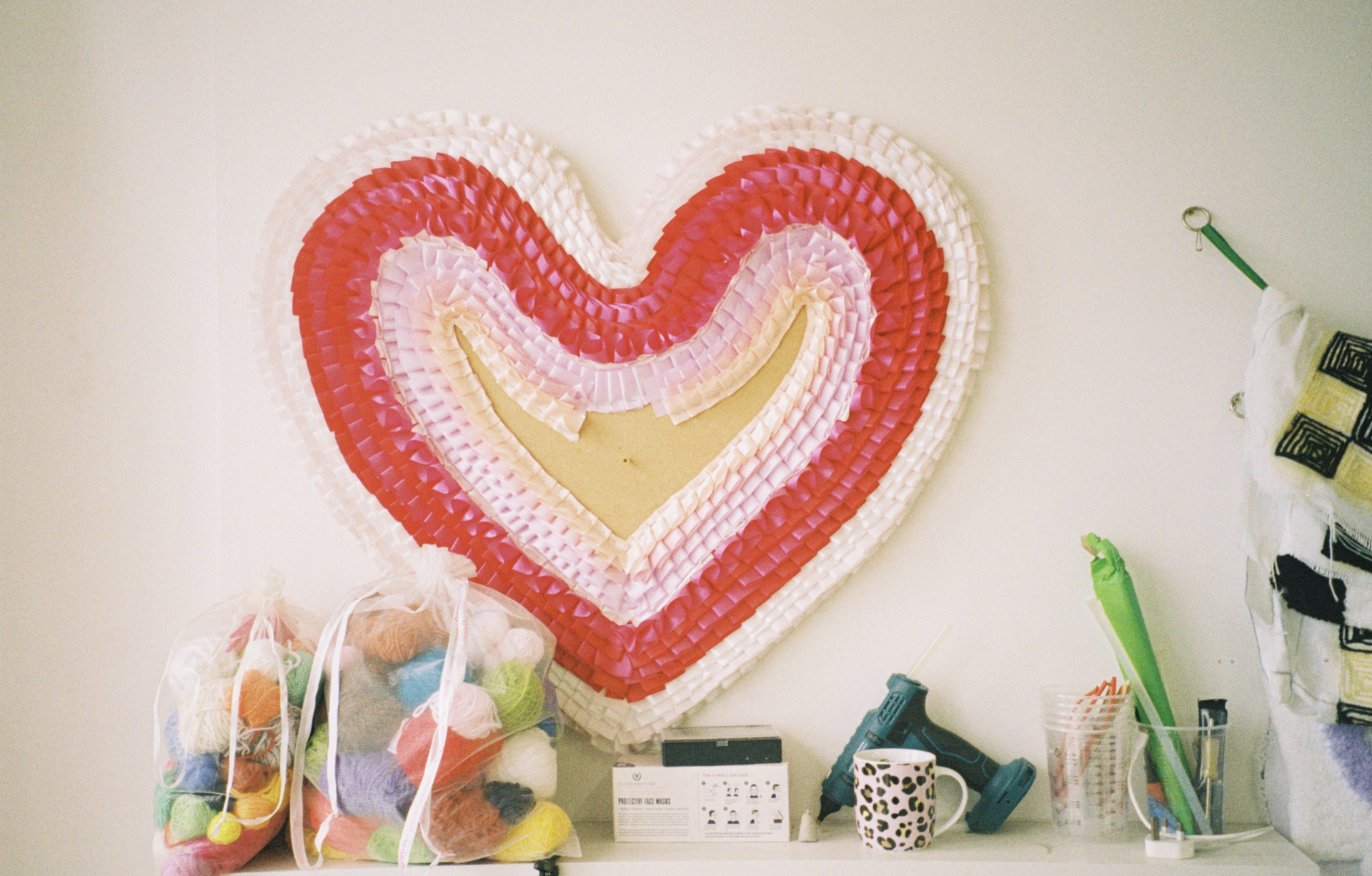
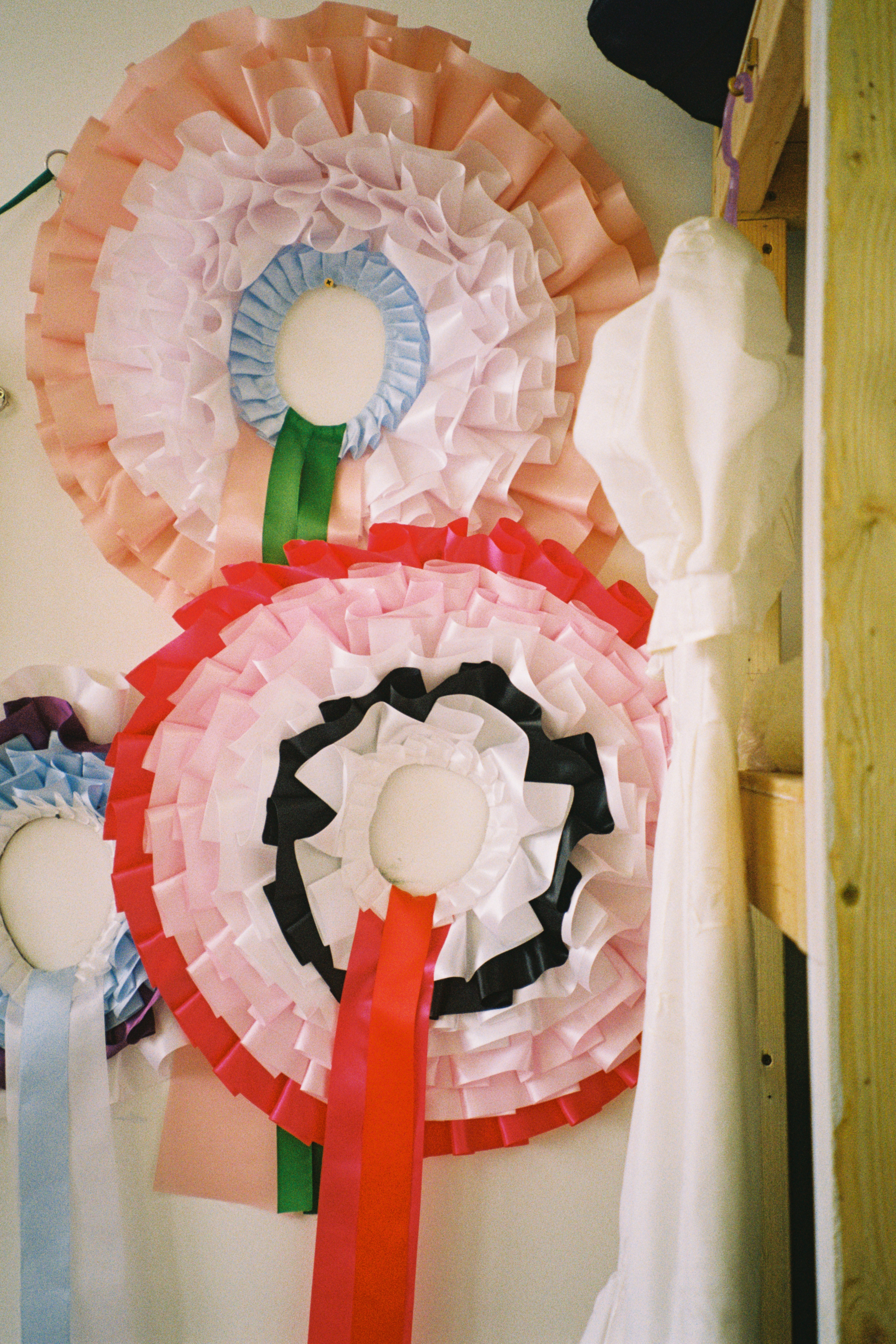
I like that element of it. I think I don’t know. I’d class myself as an installation artist, like, sculpture, but I think a really important thing for me, especially, in solo shows, is the world building element of it. I like people to come into a space and it feel completely different to a white cube. It’s definitely the two uses sort of thing. In the first sort of ever video I did for the Poodle series, the rugs were wrapped around the maquette of a poodle. It was nice to show the use. A lot of people don’t really understand what that shape is. It’s quite abstract. I once had someone ask if it was a vintage toilet rug. And it’s like, you know what? No. But like, again it goes back to that thing of like, I love hearing what people are interpreting this as. The way that I explain it to people is those images of vintage flayed lion, tiger and bear rugs. It’s basically that without the head. With other shows, I’ve had motifs that have been in the videos but it’s not essentially been that piece. So the work all kind of works together but it’s not essentially in the videos. Say for example, the rosettes on display. They all belong in the same world so they all kind of make sense together.
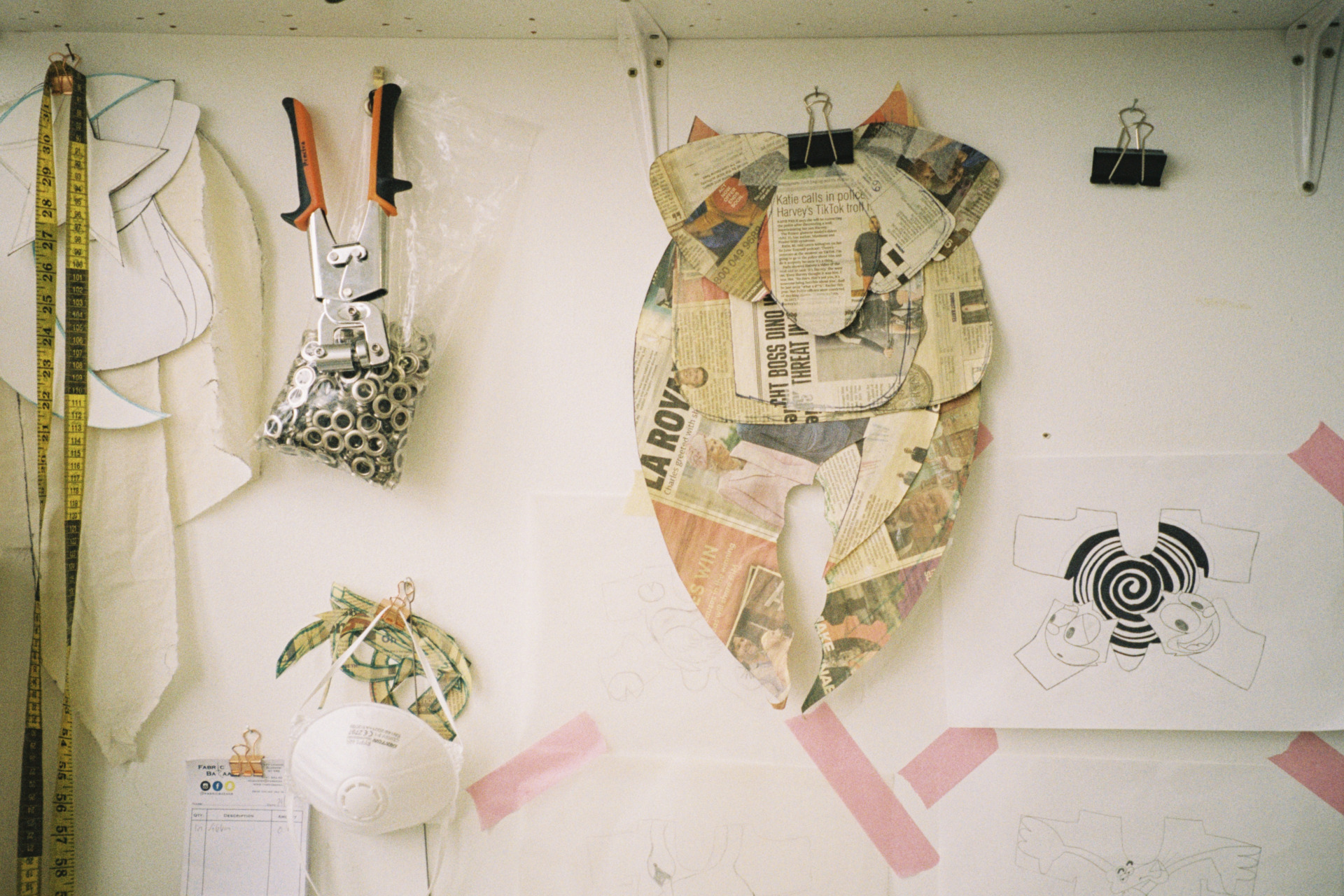
And so you’d generally work in series’?
Yeah. I’ve been using this blue fabric. I bought that fabric in the market in Turin when I did the first show of all the poodle work. We found that fabric by chance. It was a very specific blue. I was looking for the same blue as they put up in these convention centres or arenas. It’s a very specific curtain that they put up for temporary walls and decoration. I was trying to find it in the UK, and then I was like, well, that’s gonna cost a lot of money to bring in. The director of the gallery I was working with mentioned a big market in Turin, we’ll just go and we’ll just try and find it. I was stressing by this point, because it’s a really specific shade of blue and we’re going to need quite a lot of it. The alternative was to paint the gallery walls because it has to be that blue. If it was any other blue, it just wouldn’t work. It’s so significant to these competitions. If it was slightly off, it would not read the same.
We found this massive, full roll in the correct amount we needed at an amazing price. It was kind of like it came to me. I have used that fabric in every show. Whether it’s been a tiny little wall or we’ve done the whole gallery. It’s really served its purpose. It’s been everywhere. It started in Turin, then it went to London, then it went to Manchester, and then I moved up here, so it came to Glasgow, and then from Glasgow it went to Newcastle. Then it came back to me again. And then it went to London. And then it went to Mexico City. Now it’s back to London.
Over time it’s been cut to fit certain shapes. It started off as maybe twenty quite long pieces. I’ve got maybe ten complete pieces now. I’m just going to keep using it until it’s scraps. I’ll maybe do something else with it after that. I feel like I need to because it’s been such a massive part of my practice for so long.
Do you think that fabric and with each show it being less and less and less kind of determines when this series ends?
I have thought about that. It was just a random fabric we found in the market in Turin. How am I going to find that again? I don’t know if I’d want to put in the money and effort to find this like cheap polyester fabric again. After the show at SOUP, a lot of it got donated to the community group. It’s living its own lives in different bits. There’s probably little scraps somewhere in Mexico, some fashion students took some of it because it was offcuts. So it’s slowly made its way all over doing its own thing wherever it goes.
How do you determine the patterns and designs that you do on the tufting? What process goes into that? The textiles you’re making aren’t just replicas of different dogs.
Well, originally I did start by using reference photos from my other competitions. The first show I did, there were two that were kind of direct or like heavily influenced by two grooms that I’d seen. By the time I’d got to the last one of the four in that series, I’d got a bit more confident in my skills and decided to design one from scratch. It’s fun to think about what I want to see as a dog. What would I want to turn a dog into? Because also a part of the competition is an audience vote. And so I thought, if I was an audience member, what would I want to see?
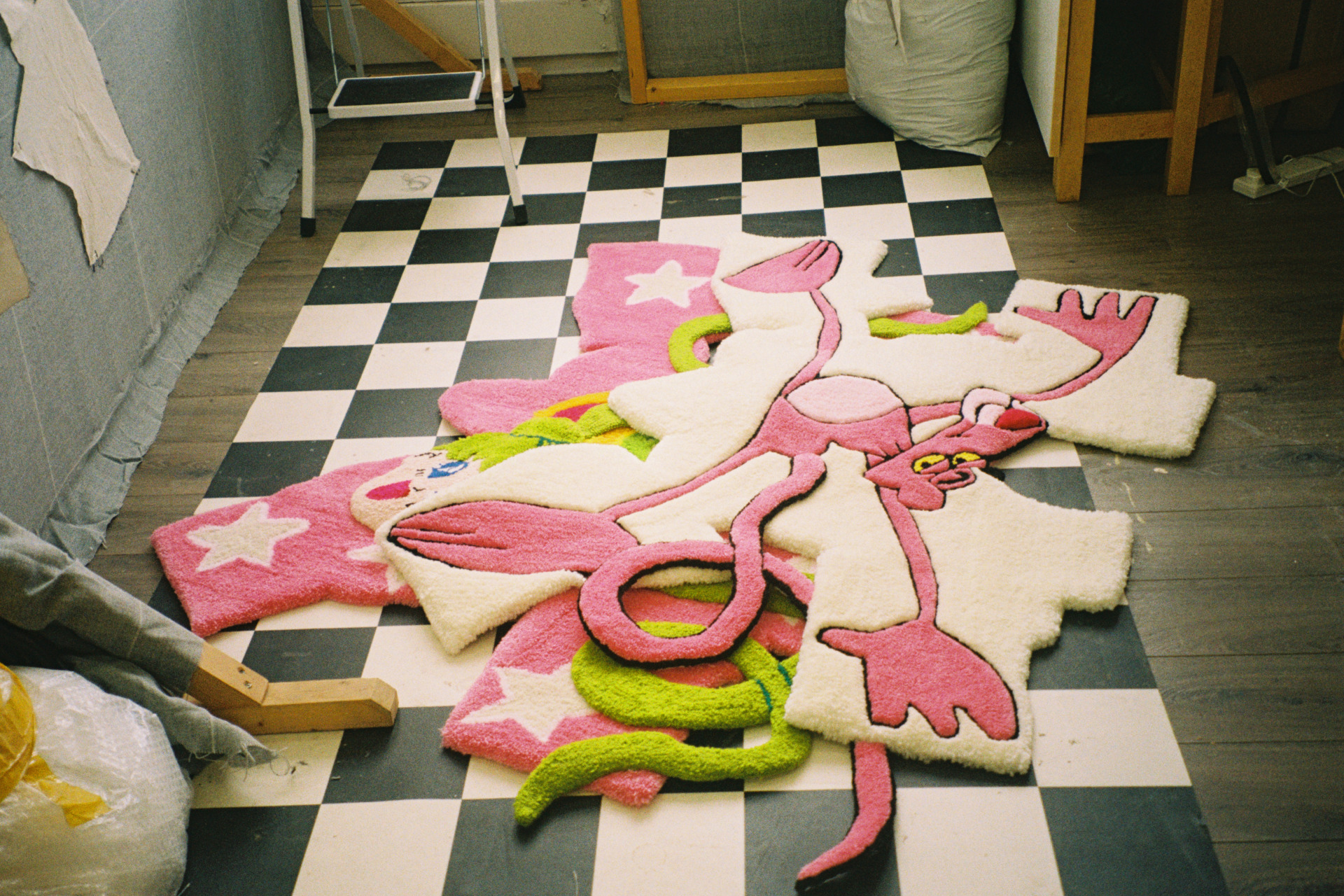
I have a lot of random photos on my phone. Sometimes the inspiration comes from a color combination I think is nice or a screenshot of a cartoon I’ve seen on instagram. I’m picking from different bits and bobs. When I do a set of them, there is a theme that runs through them. In Mexico City, I did cartoon cats, like The Pink Panther, and Felix.
For Silly Bitch at SOUP in 2025, I did four tapestries. Two were based on animals with genetic mutations. The first being a candy floss lobster that was found in Maine around 2017. The coloring was due to a really rare genetic mutation, but they couldn’t work out what had caused it to mutate that way and give the lobster pastel blue and pink coloring. The second genetic mutation tapestry was from a zebra named Tira, born in Kenya in 2019, who had a genetic mutation that made her brown and spotty. The second two tapestries in the show were based on costumes. One was Bjork’s swan dress and the other was based on a gymnastics leotard. Sometimes I go into shows thinking of a general theme, and for that one, the theme was costume.
Can you tell me about your time in Mexico City for Feria Material with SOUP? Was that your first art fair? Did that alter the way you think about how your work is perceived by a broader international audience?
Yes, that was my first art fair. Silly Bitch generated a bit of buzz at London Gallery weekend. SOUP had been recommended to do the fair for a while and the fair didn’t seem as rigid as others. I think that’s why Hector at SOUP decided to take me. My work is playful and colorful. And also, it was a fun coincidence that the people in Mexico City are obsessed with dogs. It is such a dog city. They’re everywhere, people worship them. There were so many dogs at the art fair as well which was an added bonus. The work was really well received.
There was a portrait video in the booth, which was the star. People didn’t know it was moving because it is such a slow performance and I’m trying really hard to stay still. Someone actually thought I was in the wall behind it or that it was a livestream. That piece was a really big draw card into the space.
We upholstered the whole space in eleven hours. It was an insane install. It is such a confined space that you have to work with. It really is a challenge. We basically sort of transferred what we’ve done for Silly Bitch into the booth. Originally we were meant to have two days to install, but then the fair had to move venues. That only left us one day to install. But we were like, no we can do it. We were literally the first ones in, last ones out. Luckily there was a hardware store over the road. So we were like, I got this. We were just running around all over the fucking place. But we got it done.
When you’re working on this series of work specifically, are you thinking about surrealist qualities or this idea of the uncanny, something that’s a bit familiar, but something’s quite off? Does that play any role in how you’re making your work? I’m thinking of our conversation just there about the fair and how the video work was a big draw for people because it was quite odd.
I think it comes back to the humour element of my work. It’s kind of disarming and it creates conversation. My work isn’t super research heavy. I’m not super studious. My research comes in the form of hoarding images. I’m more of a visual researcher than a text-based researcher. It comes from a collection of images and sourcing in that way. Whether it be textures or sounds, color combinations or just objects that I like the look of. Maybe that is why my work has more of a surrealist skew. It’s a slightly more obstructed way of building things.
I’m trying to create spaces that bring out different emotions in people. I had a show in the Intermedia gallery at CCA, and that’s the first time I’ve done blue flooring. Usually it would just be the blue walls. I had a blue carpet, I had the blue painted walls, and then also had the fabric, which dampened the sound. The acoustics are really flat and damp and that also adds another element to it. So when you pair a big video with me as an unnerving figure in doggy drag with a very quiet, warm environment, people are either soothed by it or unsettled. Those are the two main takeaways people have had when they’ve been in these spaces.
For Trophy Room at CCA, there was a soundtrack. It goes back to the Channel Four documentary. There were always these twinkly scores to them. I’m not sure if it’s a motif in British oddity documentaries, but there is always that kind of soundtrack. I got my friend, Oscar Marcus Boyle to recompose ‘The Winner Takes It All’. We stretched it into ten minutes. Again, it created quite a surreal environment where it’s quite warm and dull.
Since it was quite dark in the room, we spotlighted things. Some people were really creeped out by it and some people were really soothed by it. It was the same for Silly Bitch as well because instead of the floor, we’d done the ceiling. SOUP is like a white cube gallery. But by using the fabric on the ceiling, we made the gallery feel like a competition tent. I like to freak people out. The core of my work is that it’s a little bit freaky.
A little bit freaky. Strange, strange little creatures. Strange, freaky, and uncanny.
Yeah. I like it. There you go. I like a strange little guy, you know.
—
In the Studio is a monthly series interviewing Scotland-based artists and curators in their studios, conducted by Chaz Scott, a curator and art historian based between Baltimore, Maryland and Glasgow, Scotland.