
Reviews
John Wood, Celine
Review by Toby Üpson
John Wood
Celine
11.07 – 02.08.2026
The photographs in John Wood’s exhibition at Celine are black and white, mostly. Their subjects straightforward: hunky men in states of undress, the occasional willy dangling proud. Un-pornographic, sans illustrative gest, these images celebrate intimacy, demonstrating Wood’s to be an art that speaks across generations.
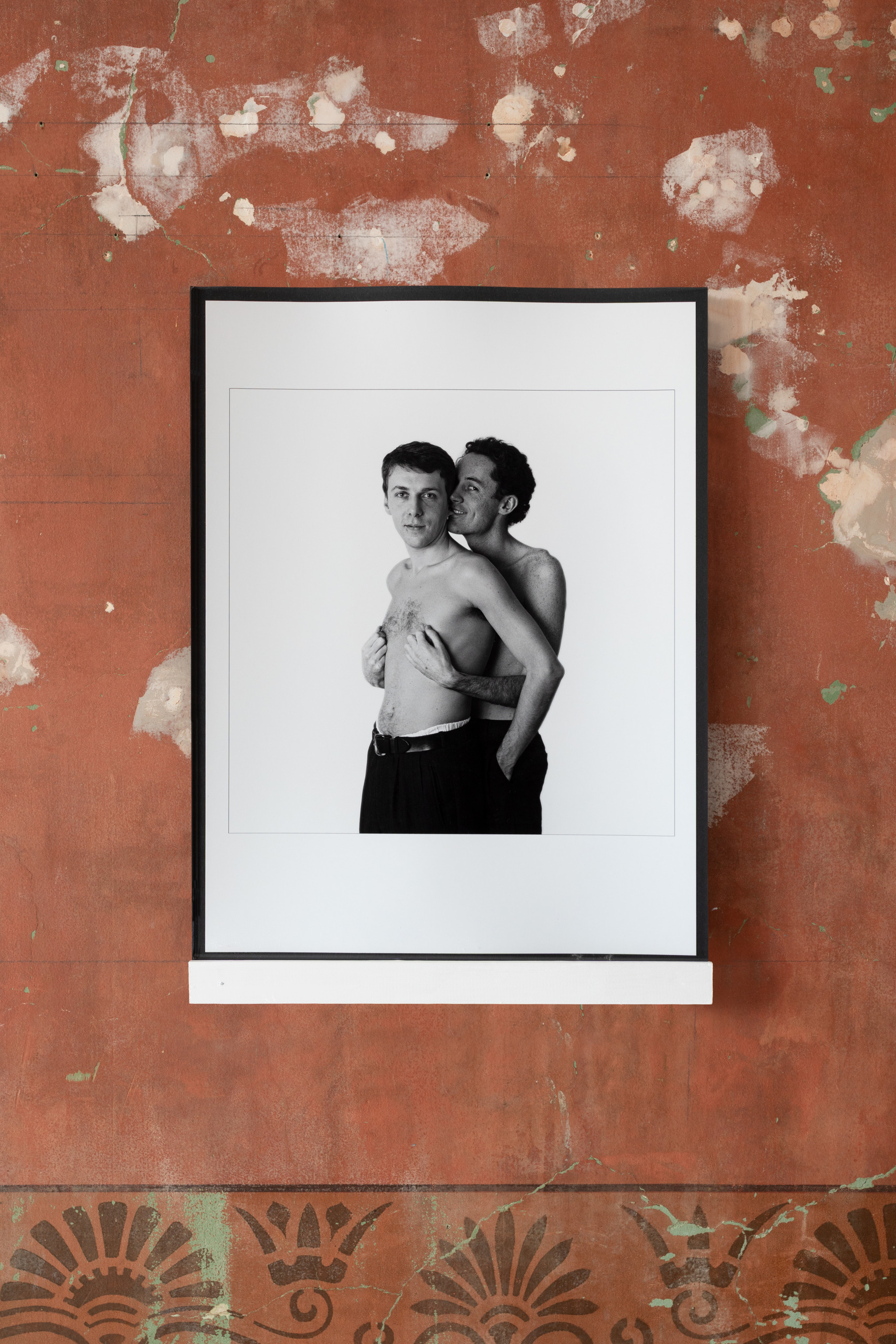
There is not much information out there about the Wood. Born in 1947, I want to suggest he’s something of a Glasgow Boy; a lifelong Glaswegian, his work driven by realism and the narratives which might entangle a figure. The exhibition’s press release mentions that Wood started making photos as a teenager, with his ‘practice becoming more serious’ once he embraced the medium-format––a film format larger than 35mm, prized for its high resolution. Wood’s studio portraits attest to this quality. Here, figures flash free from white grounds, inviting us into revel with the cheekery they depict. In Roberto and Andrew 1996 (1996), for example, the gaze of the couple embracing welcomes us as potential participants of this courting scene––who will have their nipples tweaked next? Inversely, positioned next to these white images, leather men emerge from shadows, thick, dewy and black, evocatively dominating us through their averted looks. The sitter in September 1994 (1994) is a top for sure; with his eyes turned towards his veined member, the photo begets body tingles––a mix of anxiety and anticipation, the stuff of a sweaty night (to get carried away).
These portraits are not about the sitter as an object, innately self-contained, the stuff of commercial photography. They testify to how a subject is born through layers of relation, felt or desired. The staging of such an interplay proves Wood’s filmic credentials. More so, with each photograph pointing towards a narrative held in the subject’s pose, these images position Wood as a true artist; concerned with the feeling ignited through his work.

The formalities of the exhibition’s making accentuate Wood’s artistic sensibility. Curated by Glasgow-based artist, researcher and lecturer in Fine Art at City of Glasgow College Steven Grainger, the photographs have been selected in conversation with Wood from his ‘extensive archive’ of such imagery. The first time artworks from this archive have been shared publicly, the pair knew what they were doing with this show, framing Wood as a refined maker of photographs, not some Saturday night snapper. This delineation seems important; Wood is something of an outside figure to the rigmarole of the art world, with his artistic being constituted by human connections and not by a tick list of exhibitions. It’s of note that Wood often worked in ‘duplicate’, creating two copies of his photos, one of which he gave to his sitters and one that he kept safe for himself. The setting of Celine, an artist-run space in a private residence, seems fitting in this regard; with its filler-speckled walls, the gallery stands in stark contrast to normative white cube settings, referencing all the art that once called this place its temporary home.
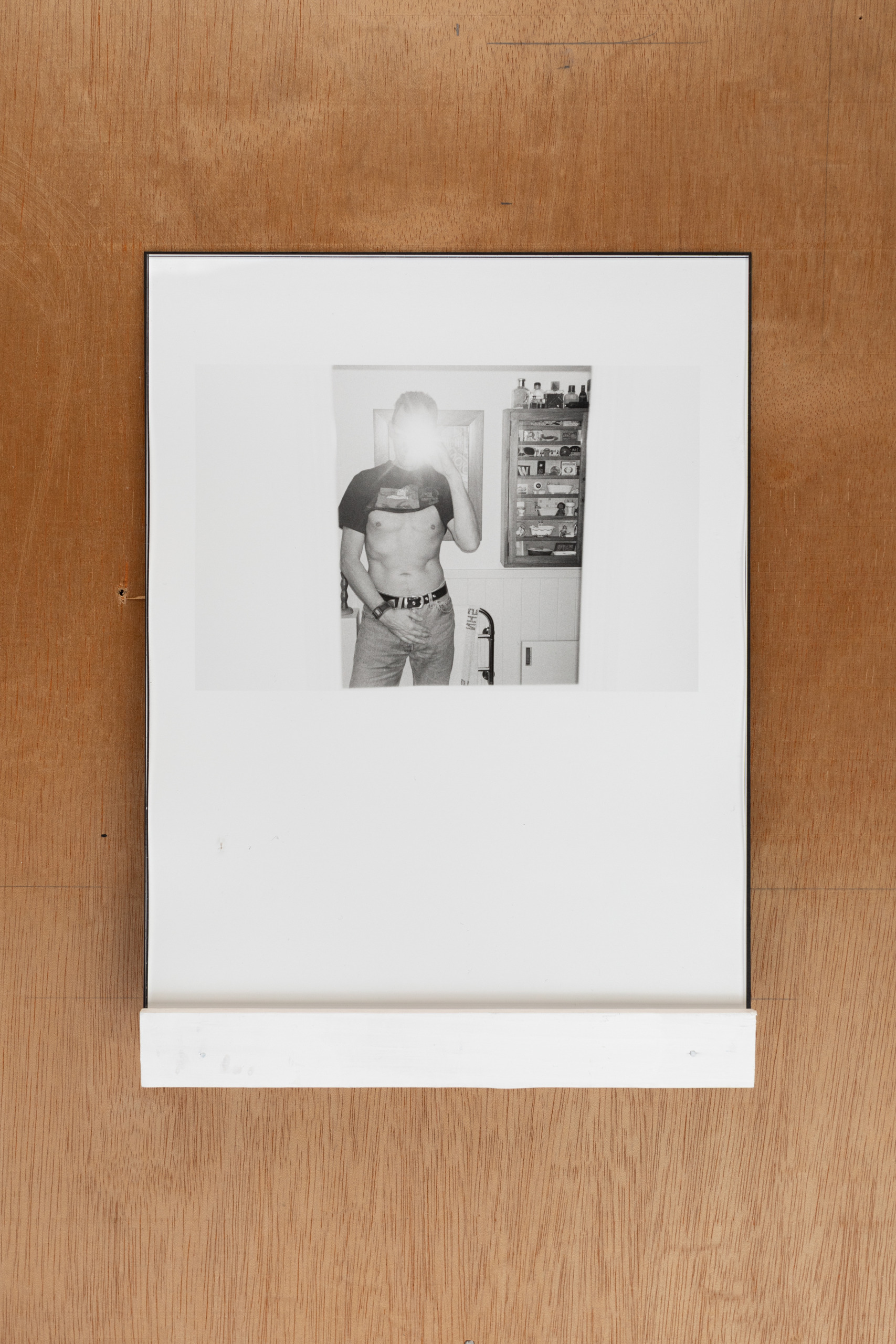
This gentle move into the public also suits Wood’s practice, his subject matter, and the motivations birthing these images. Opting––or rather having––to make his photographs from his flat in Hyndland, Wood’s art has an honest crispness––the speckled grain of 35mm is forgone in favour of the smoothness made possible through medium-format photography. Read as metaphor, this formal clarity pays testament to the personal relationships that have guided the selection of the exhibited work. Each of the photos displayed depicts a member (pun intended) of Wood’s ‘extended network’––his friends and lovers, as well as residents or those visiting Glasgow fleetingly––souls who resonated with him and who have shared the fact of his being. The two smallest photographs in the exhibition evidence this. Unlike his studio portraits, Self portrait (c. 1985) and Cal (c. 1982) show their sitters within a domestic space, respectively, before a bathroom cabinet, topped with at least 10 bottles of perfume (a detail I had to note), and leaning nonchalant next to a sideboard housing the artist’s vinyl collection.
A bathroom mirror snap and a Polaroid, Self portrait and Cal seem like the most unstaged photographs in this exhibition. And yet they hold so much of the interplay Wood works into the other images seen––we have an occluded gaze (Self portrait) and one which steams out of chemical sheen (Cal), a gesture towards undress (Self portrait) and one provocatively erotic (Cal). Here, that is, as self rhymes with another, we materially witness the intimacy core to Wood’s art––how his practice has been ‘shaped by his connection with his sitters’, the trust they place in him as they make themselves vulnerable to his camera, as well as how his chosen photographic medium shapes how this relation finds form. In attuning to such human feeling, Wood’s art speaks to me, someone almost 50 years his junior, as a moment of celebration. A vital moment that is; one of joy, one longed for, one which often follows a period of darkness or struggle which many people have and continue to face. I hope I don’t have to explain the importance of such moments for those courting a life queer.
Toby Üpson is a writer based in Glasgow.
Images: Installation view, John Wood, Celine, 2026. Photo credit: Patrick Jameson.