
Articles
Splashing all over the place
Helen Charman
So, where are we now?
Have we approached the rather large weapon of Art Writing with any assurance, sniffing its weak spots, poking our fingers in them, and loving it all the more for it?
Or have I put you off reading (not to mention producing) Art Writing altogether?
I’ll begin by answering, in a roundabout way, the question Maria Fusco poses at the end of ‘Contemporary Art Writing and its Environs’ published in MAP magazine in 2008. For a long time, I was put off reading Art Writing, and I had no intention to either produce it or be involved in its production. I hadn’t been to art school, I hadn’t taught anywhere other than English Literature departments, and I was steadfastly, sanctimoniously committed to experimental Marxist-feminist lyric poetry as the only real™ mode of experimental communication. To me, immersed as I was in typescripts and xeroxes, pamphlets, papercuts and stapler injuries, writing’s relation to image was always secondary.
It is probably not necessary to spend much time here pointing out that, in order to make it out of your early twenties alive, you have to stage manage a series of dismounts from high horses of your own making.
In this piece, published in MAP magazine in 2008, Fusco offers a series of definitions of the still-nascent form — she had founded the influential MFA in Art Writing at Goldsmiths only the previous year — that embrace its ambivalence, its porosity, refusing the pretence of objectivity:
When I was supposed to be making objects, I wrote. When I wrote, I hid it. I continued to hide it for many years, until it began leaking out. Now it’s splashing all over the place. And where am I amidst all these words? Well here I am writing them of course.
In that ‘I’, I can see the experimental possibility that poetry affords, too. A splintering subject, splashing around in all its memorialised missed connections. Language making a real show of itself. ‘Weird nomenclature,’ Fusco’s definitional list begins, paginated like a lyric poem, settling on— ‘for the time being’— ‘writing with art’. Okay. I’m sold.
—
Another thing to like about it: writing with art requires very few expensive resources. A library card. The internet. A pencil.
—
I used to work at MAP. I joined in early 2020, immediately before the COVID-19 pandemic, as an editorial resident, where I ran my own year-long project, TENANCY, as well as commissioning across the magazine, and I left at the end of 2021. Mostly, I loved it: for its space to experiment, its invitation to commission ambitiously and creatively, and because it was the job that brought me to Glasgow. It was also frustrating, not least because of the stipend (low) and the fee available for writers (lower). MAP was not specifically or exclusively a home for Art Writing, and it had a long history, especially in its former physical print edition form, of intertwinement with Glasgow’s establishment visual art scene: the very first issue, which was released in 2005, tied in explicitly with ‘Zenomap,’ the Scottish pavilion at that year’s Venice Biennale.
By the time I joined, though, it felt like a publication that had a clear relationship to the form and a burgeoning archive of examples, always my favourite pieces: ‘Objects I have Been’ a reviews season in the ekphrastic mode commissioned by Daisy Lafarge; Nisha Ramayya’s ‘A woman is our happy issue’, a response to Hannah Black’s 2017 exhibition ‘Some Context’ at Chisenhale; the commissioning work done by my editorial peers Alison Scott and Rosie Roberts, who make their own interdisciplinary work as again+again, who have recently launched PAMphlet. It was also, through the editorship of Laura Haynes, Programme Leader of the MLitt in Art Writing at the Glasgow School of Art, connected to it in an institutional sense, alive to the changing modes through which visual artists and writers related to each other.
In late 2019, to accompany the announcement of the three new editors, I chose an image that I’d found in the Mitchell Library, flipping through David Katz’s 1968 Psychological Atlas with 400 Illustrations, ‘A “Social Situation” as Depicted by a Young Child’:
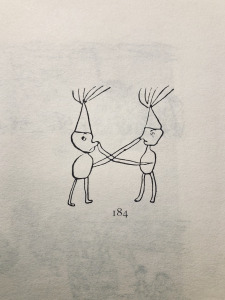
There they are! Art and language, communicating.
—
So much has happened since 2008, when Fusco’s essay was published and the storm clouds of the financial crash began to seriously gather, that it’s difficult to merely gesture towards the changed landscape I’m writing into. In general, though, we can attribute the immiseration of the present moment to both the national legacy of the Conservative-led coalition government’s austerity programme, implemented in 2010, and to the specific financial mismanagement and brazen corruption of Glasgow City Council. Across the city, cultural facilities are closing: the Mitchell Library itself is literally collapsing, the People’s Palace is closed indefinitely, the Queens Park Glasshouses are closing, City Property — an ‘arms-length organisation’ which manages the council’s ‘property assets’ — has evicted the residents of Trongate 103, which includes Project Ability, Glasgow Print Studio, Transmission, with 28 days’ notice, and the CCA, where MAP used to be a cultural tenant, has filed for liquidation. Amidst the general crisis in higher education, at GSA the MLitt in Art Writing is being withdrawn, and its sister programme at Goldsmiths no longer exists. And neither does MAP.
This kind of enforced decline is political, and targeted. It denies the people of the city access to what belongs to them, and it further enshrines artistic and literary production as the pastimes of the wealthy and the privileged.
—
I am conscious that my intentional self-reflexive use of a fragmentary style could be seen as an excuse for my failure to look for too long at the total bleakness of the political situation we find ourselves in in 2026.
—
Long before I began working for MAP, and long before I really had any sense of my own writing or reading practice, I encountered art writing for the first time in the least productive way possible: a reading at a private gallery in London, a haphazard, lazy and noncommittal practice of nepo babies and heiresses. Around this time, I wrote a poem called ‘Attachment Barbie’ that ended like this:
From horse girls bloom posh
women but the worse thing
is stealth money: quiet
voiced curators or the sickly
kitsch of approximated
marginality. Tacky
to the touch. What is art
writing [voice breaking] what
is art writing [smashing a glass]
I am not [panting] leaving until
[shaking] somebody explains
to me [smashing another glass]
what art writing is
—
Hey, I think to myself, reading it again almost a decade later: sometimes I still feel like that (subjective). And: is this where we’re heading back to? The absolute lack of resources and the platforming only of the hobbyist class? (objective).
Helen Charman is a writer who lives in Glasgow. Her first book, Mother State: a political history of motherhood came out with Penguin/Allen Lane in 2024.
MAP was a non-for-profit digital platform dedicated to the discussion and support of artist-led publishing and production. Launched in 2005, after 25 issues in print, MAP was recast in 2011 as an online project with occasional print and production projects attached, led by editorial directors, Alice Bain (founding editor) and Laura Haynes.