
What Everyone Wants
France-Lise McGurn
The Modern Institute (Aird’s Lane)
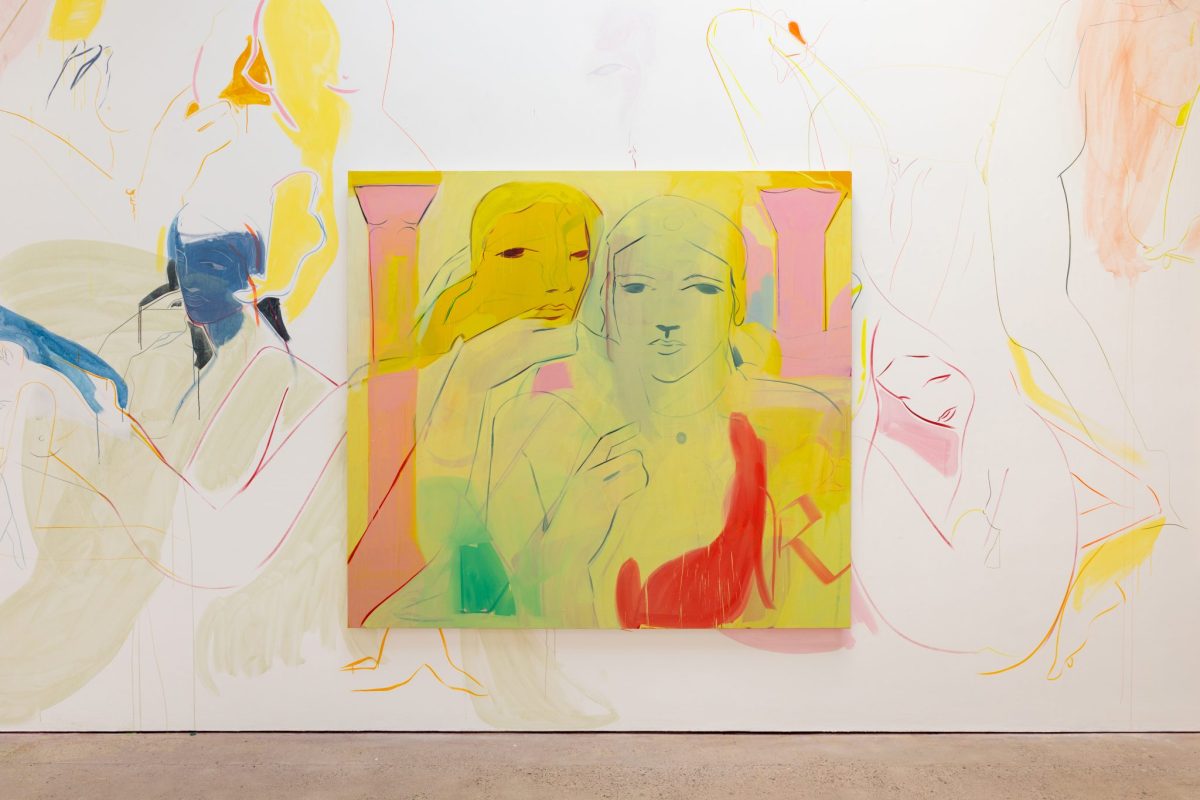 France-Lise McGurn, ‘To Die For’, Oil and marker on canvas, 2024

Installation view, France-Lise McGurn, What Everyone Wants, The Modern Institute, 2024
 France-Lise McGurn, ‘Shampoo’, 2024 and ‘Film Bang’, oil and marker on canvas, 2024.

Installation view, France-Lise McGurn, What Everyone Wants, The Modern Institute, 2024

Installation view, France-Lise McGurn, What Everyone Wants, The Modern Institute, 2024
 Installation view, France-Lise McGurn, What Everyone Wants, The Modern Institute, 2024
 France-Lise McGurn, ‘Boyfriends’, oil and marker on canvas, 2024
What Everyone Wants
15/03—20/04/2024
Monday—Friday: 11am—6pm
Saturday: noon—5pm
LINES
A Cambridge academic on a podcast discusses Susan Sontag. How her ‘erotics of art’ explains Donald Trump. The male voice is that of New Labour, a liberal think tank, the sound of technocratic competence, and though I know it’s a tone that covers and occludes, I find it comforting, despite myself. The form convinces, regardless of the content. I’m mopping the floor on a half-bottle of Chianti and the argument eludes me, but it recalls a well-known anecdote. It’s the early 1960’s and Sontag is talking to friends – talking at friends – about a particular artwork, marshalling a cerebral arsenal – Freud, Nietzsche, Lukács – to elucidate its meaning. Amongst the company is the artist Paul Thek who turns to her, exasperated. “Susan, stop, stop, stop,” he says. “I’m against interpretation. We don’t look at art when we interpret it. That’s not the way we look at art.”
Seems too obvious to say why that comes to mind now.
Yellow. Your hair was bleached. Red knee-high boots. Bardot on the TV, insouciantly ambivalent because Michel Piccoli has sold-out. I loved her wearing that bandeau. I loved the red Alfa Romeo Spider, the cypress trees. Ghosts of a fire. Cinecittà. Fritz Lang as an archetype of seriousness, like Thomas Mann was for Sontag. Resigned, German and exilic. Antique statues wear scarlet lipstick and neon blue eyeliner. On the podcast: “Cinema is clean, rapid and direct. When you’re at the cinema you don’t have time to waste time interpreting it… Images come in rapid succession. Bang. Bang. Bang.”
Images come in rapid succession. I’m on the phone to a friend of the photographer Peter Hujar, interviewing him for the umpteenth time for the book I’m writing. He’s coughing intermittently, and his voice is slighter and more rasping than usual. I ask whether he has a cold. “No, it’s not a cold. It’s the cough,” he says. “I worked as the director of public programmes at the South Street Seaport Museum at the time of 9/11. I was downtown the whole time, I breathed it all in. If I can get insurance, then it might be treatable.”
This is a man who survived the AIDS crisis. If survived is the right word.
The body is an archive.
Your hand holds the brush, dips the brush in blue paint, and then it performs this act, and everything is present – caffeine nerves, Rita and Rita, lack of sleep, a dull muscle pain in your side, the pulse in the vein just below your right eye, your father, the tightness on your hand where the yellow paint has dried. Various hungers. The junked and cataclysmic world. And then it all draws back, pools or settles or makes a fist somewhere in your stomach. And there is a line on the canvas as elegant and expressive and sensual as a dance. And there is grace and tactility, and there is form as the historical trace of a body. And really it doesn’t redeem anything, who could ask or imagine such a thing now. But it attests to the presence of a charismatic embodiment. A dear one.
How to account for any of it really? Walking through the blue gloaming at Newington Green on the 24th of February 2024. I knew I’d claim the right to make this text hermetic, to indulge the personal and exclude the reader, but now, faced with all my history with your work, faced with our history and faced with living through this history… Lorca said to me the other day, “Dad, what is larger, a raindrop or a teardrop.” And I’ve been on the verge of tears, who hasn’t these past weeks. That’s not a confession, not an attempt to claim some kind of special sensitivity on my behalf. Say that the body is an archive. Say that the words on this page are the cough. Say that the line on the canvas is the cough. Say that while I was walking through the blue twilight, I was gladdened to think that you were somewhere in this city. Gladdened to think you were making a painting that might be, in some small but important way, a promise.
On the podcast, the Cambridge academic says, “experience is out of control.”
– John Douglas Millar
Photo credit: Patrick Jameson. Courtesy of The Artist and The Modern Institute/Toby Webster Ltd, Glasgow.